

Nigeria, Africa’s largest oil producer, missed its OPEC production targets for nine months in 2025 and again in January 2026, resulting in an estimated loss of $1.31 billion in potential crude revenue, according to data from the Nigerian Upstream Petroleum Regulatory Commission.
Using the Central Bank of Nigeria’s average Bonny Light price of $72.08 per barrel for the period with available data, the country’s 18.12 million-barrel production shortfall translates to roughly N1.76 trillion at an exchange rate of N1,353 per dollar.
Despite favorable global oil prices for much of the year, production remained inconsistent. Bonny Light opened 2025 at around $80.76 per barrel, dipped to $65.90 in May, recovered to the $70–73 range in the third quarter, then eased again in October.
Fluctuating Output
Nigeria surpassed its OPEC ceiling only in January, June, and July 2025. In contrast, production fell below the 1.5 million barrels-per-day quota in February, March, April, May, August, September, October, November, and December. September recorded the largest deficit, with daily output at 1.39 million barrels—about 110,000 barrels short of the target—resulting in a monthly shortfall of roughly 3.3 million barrels. By comparison, January output exceeded the quota by about 40,000 barrels per day.
Accounting for small surpluses earlier in 2025, the net production gap was 16.85 million barrels, with an additional 1.27 million barrels missed in January 2026, bringing the 13-month cumulative shortfall to 18.12 million barrels.
Financial and Fiscal Impact
Even with the underperformance, Nigeria produced approximately 530.41 million barrels in 2025, generating gross revenue estimated at N55.5 trillion based on average prices and exchange rates. Analysts caution that these figures represent gross revenue and do not account for operational costs, joint venture obligations, production-sharing recoveries, domestic supply needs, or losses from oil theft.
Experts emphasize that Nigeria’s main challenge lies in production volumes rather than global oil prices. Professor Emeritus Wumi Iledare noted that achieving output goals requires practical measures such as strengthening security around oil infrastructure, minimizing operational disruptions, streamlining regulatory approvals, and ensuring a stable investment environment. He also highlighted the importance of maintenance, infill drilling, and policy consistency to convert planned production into actual output.
In 2025, Nigeria earned roughly N55 trillion from crude, up from N50 trillion in 2024, but still below federal expectations. The government had aimed for 766.5 million barrels but achieved closer to 599.6 million, leaving around 167 million barrels unproduced.
Economics Professor Segun Ajibola pointed out that output depends on factors beyond the government’s control, including cooperation among joint venture partners, international market dynamics, environmental conditions, and internal issues at the state oil company that have slowed reform efforts.
January 2026 and Outlook for 2026
OPEC reports indicate that Nigeria’s daily production in January 2026 was about 1.46 million barrels, slightly above December’s 1.422 million barrels but still below the 1.5 million-barrel quota. This marked the sixth consecutive month of missed targets from August 2025 through January 2026.
The production shortfall raises concerns about Nigeria’s 2026 budget projections. The government now plans a conservative benchmark of 1.84 million barrels per day, including condensates, at $64.85 per barrel and an exchange rate of N1,400. January figures suggest the year has started under fragile conditions.
New Nigerian Upstream Petroleum Regulatory Commission CEO Oritsemeyiwa Eyesan outlined strategies to boost production, focusing on operational efficiency, predictable regulations, safe operations, and revenue growth. This aligns with President Bola Tinubu’s target of increasing crude output to 2 million barrels per day by 2027 and 3 million barrels by 2030.
Global Significance
Nigeria’s oil performance remains under close scrutiny by investors in New York, London, Toronto, and Beijing. As Africa’s largest economy and a major OPEC member, its production levels influence not only domestic revenue and fiscal planning but also global oil supply stability and market expectations.
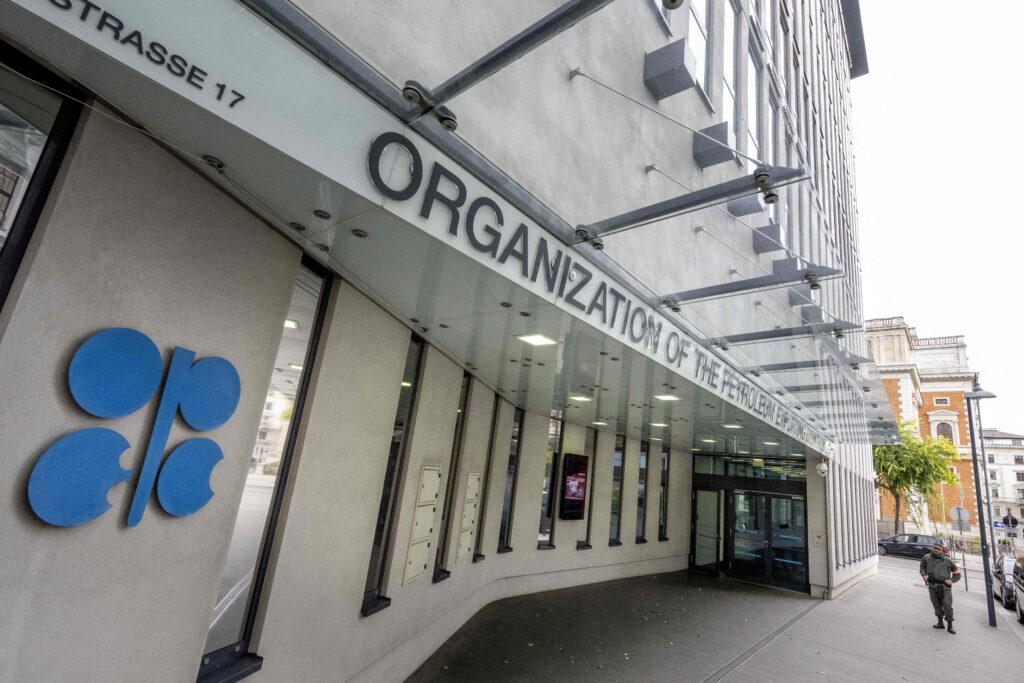
The face-to-face meeting of the 13 OPEC members led by Saudi Arabia and its 10 allied members headed by Russia will be the first in the Austrian capital since the spring of 2020. (Photo by JOE KLAMAR / AFP) (Photo by JOE KLAMAR/AFP via Getty Images)