

Officials in Côte d’Ivoire are evaluating a potential downward revision of cocoa payments to farmers, a move similar to the recent pricing adjustment announced by Ghana, reflecting mounting stress within the world’s primary cocoa-producing hub.
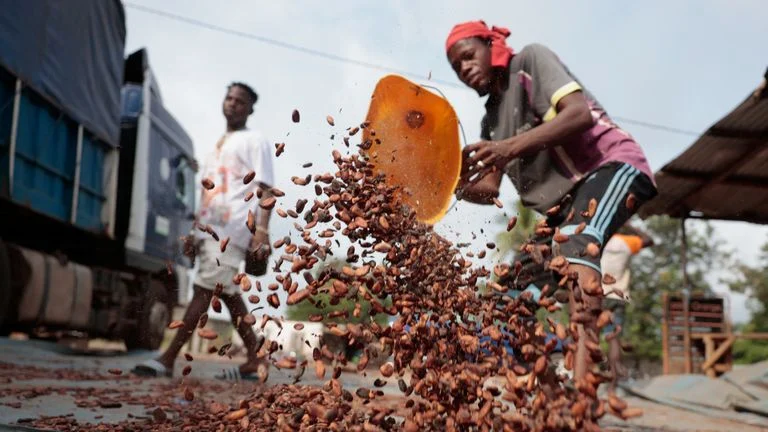
Sources familiar with the matter say authorities are examining multiple policy paths after a sharp downturn in international cocoa values. Ghana earlier reduced what it pays growers by 28.6% for the remainder of the 2025/2026 harvest season to align domestic prices with weaker global trends.
The producer price which determines farmers’ immediate earnings after selling their beans directly shapes incomes for millions of small-scale cultivators across West Africa, where cocoa remains a key driver of foreign exchange revenue.
Together, Côte d’Ivoire and Ghana account for about 60% of worldwide supply and have been working jointly through the Ivory Coast-Ghana Cocoa Initiative to coordinate strategy.
Deliberations are said to be at an advanced stage, with one senior official indicating that decisive steps could be announced shortly. The discussions come as cocoa contracts traded on the Intercontinental Exchange have fallen to their lowest point in roughly two and a half years, partly due to concerns over unsold stockpiles in both nations.
Policymakers argue that preserving the sustainability of the cocoa industry has become increasingly urgent. An inter-ministerial panel has reportedly convened to assess the situation, although no formal declaration has yet been issued.
Market stakeholders remain in close communication. Alex Assanvo, Executive Secretary of the Ivory Coast-Ghana Cocoa Initiative, noted that trading units within Côte d’Ivoire’s Coffee and Cocoa Council and Ghana’s COCOBOD continue to engage as volatility persists.
He also reiterated support for the Living Income Differential introduced in 2019, saying recent turbulence reinforces the case for stronger price-protection mechanisms.
Exporters based in Abidjan increasingly expect an adjustment, with some industry players suggesting the debate has shifted from possibility to timing.
For multinational chocolate producers and investors, the anticipated move highlights deeper structural strains in the global cocoa market that could alter supply patterns across West Africa.