

The G7 nations are set to convene an urgent meeting on Monday to address soaring oil prices, as crude surpassed $100 per barrel and global stock markets fell amid the escalating US-Israel conflict with Iran.
Finance ministers from major industrialized economies, including UK Chancellor Rachel Reeves, will discuss the broader economic consequences of the ongoing hostilities.
Brent crude climbed close to $120 on Monday amid fears of extended disruptions to energy shipments through the strategic Strait of Hormuz, while the UK’s FTSE 100 index declined by 1.5%.
Reports indicate that the G7 gathering may consider a coordinated release of petroleum reserves, overseen by the International Energy Agency (IEA).
Such a release would mark the first coordinated action since 2022, when reserves were tapped in response to Russia’s invasion of Ukraine.
Disruptions to energy flows from the Middle East risk driving prices higher for both consumers and businesses worldwide. Analysts warn that this could lead central banks to scale back expected interest rate reductions amid rising inflation.
Approximately 20% of global oil exports typically pass through the Strait of Hormuz. However, tanker traffic has largely halted since the conflict began over a week ago.
On Sunday, Iran appointed Mojtaba Khamenei as the new Supreme Leader, succeeding his father Ali Khamenei, signaling that hardliners remain firmly in control amid the ongoing conflict.
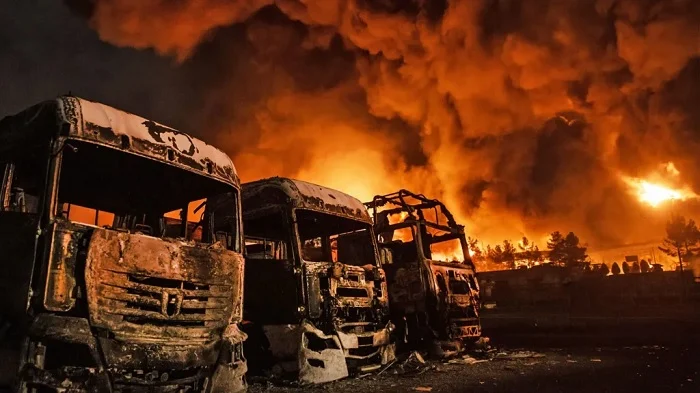
Fresh US and Israeli airstrikes over the weekend targeted multiple locations in Iran, including oil storage facilities, while Iran retaliated by striking energy infrastructure in neighboring Gulf states. Saudi authorities reported intercepting and destroying two drone attacks aimed at a major oilfield overnight.
In Asian markets on Monday morning, Brent crude surged more than 25% to briefly reach $119.50 per barrel before settling around $107. West Texas Intermediate (WTI) mirrored this trend, trading near $104 per barrel.
Natural gas prices also jumped, with UK month-ahead gas contracts spiking almost 25% to 171p per therm before easing back to roughly 156p.
European equities opened lower following sharp losses in Asia, with Germany’s Dax and France’s Cac 40 down about 2.5%. In London, most FTSE 100 shares fell, though oil majors BP and Shell recorded gains.
Markets in Japan and South Korea also suffered heavy losses. The Nikkei 225 slid 5.2%, while the Kospi dropped 6%, with trading briefly halted by a circuit breaker designed to curb panic selling.
Adnan Mazarei of the Peterson Institute for International Economics noted that the oil price spike was expected given halted production in some Gulf countries and signs that the conflict may be prolonged.
“People are realizing this conflict won’t end quickly,” Mazarei said, adding that the assurances offered by the US are “becoming increasingly unrealistic.”
US President Donald Trump, who has campaigned on reducing living costs, downplayed concerns over rising fuel prices. On Sunday, he wrote on Truth Social: “Short term oil prices, which will drop rapidly when the destruction of the Iran nuclear threat is over, is a very small price to pay for U.S.A., and World, Safety and Peace. ONLY FOOLS WOULD THINK DIFFERENTLY!”
Meanwhile, US Energy Secretary Chris Wright told broadcasters that Israel, rather than the US, was targeting Iranian energy infrastructure, even as domestic gasoline prices showed upward pressure due to the conflict.
Data from the motorists’ group AAA revealed that the average price for regular gasoline in the United States increased 11% last week to $3.32 per gallon.