

Rwanda plans to invest up to $6 billion in nuclear power plants as part of its long-term strategy to secure reliable electricity and drive economic growth, President Paul Kagame announced on Tuesday.
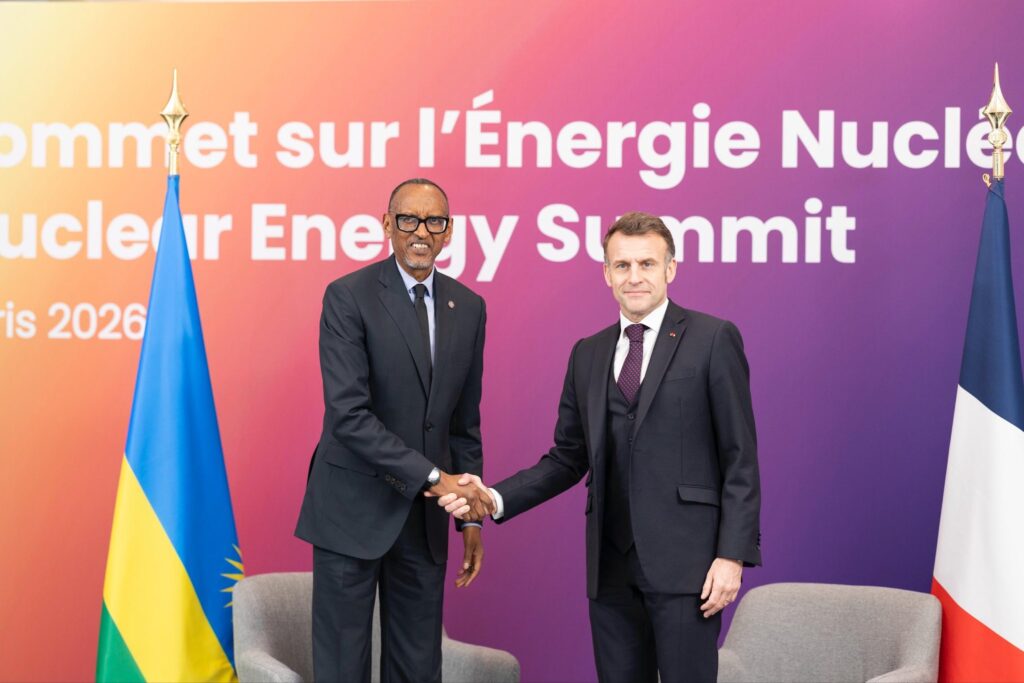
Speaking at a global nuclear energy summit in Paris hosted by French President Emmanuel Macron, Kagame highlighted the importance of international financing to support developing countries in building nuclear infrastructure.
“Nuclear energy is central to our plans for Rwanda to become a high-income nation by 2050,” Kagame said. “Achieving this requires abundant and reliable electricity, which is why nuclear will play a key role in our strategy.”
Rwanda has expanded electricity access in recent years through hydropower, solar, and methane projects, but officials say the country needs more stable power to support industrialization, digital infrastructure, and other sectors. Nuclear energy, Kagame said, could provide the baseload electricity needed for manufacturing, mineral processing, and data centers.
The plan focuses on small modular reactors (SMRs), a newer nuclear technology that is smaller, more flexible, and easier to deploy than conventional plants. SMRs are considered well-suited to countries with relatively small electricity grids, Kagame noted. The nuclear program aims to boost Rwanda’s electricity capacity to roughly 5 gigawatts by 2050.
Preparations and workforce development
Rwanda has laid the institutional and technical groundwork for nuclear development, establishing the Rwanda Atomic Energy Board and collaborating with the International Atomic Energy Agency (IAEA) to strengthen regulatory systems, safety standards, and technical expertise. Hundreds of Rwandans have already received training in nuclear science and engineering, with a goal of 230 specialized professionals by 2028 to operate and regulate the sector.
A recent IAEA review confirmed Rwanda has met key requirements to advance its nuclear program to the next milestone phase.
Financing challenges
Despite progress, Kagame said financing remains a major hurdle for nuclear projects. He called on international financial institutions to develop tailored funding mechanisms for developing nations, noting that the World Bank is beginning to reconsider restrictions on nuclear financing.
International partnerships
Rwanda has signed agreements with global firms, including Dual Fluid Energy Inc. from Germany and Canada, and is exploring SMR development with partners from Russia and the United States. SMRs can be built on relatively small sites of 15–50 hectares and operated by about 230 staff, making them suitable for emerging markets.
Kagame emphasized the potential of nuclear energy to reduce greenhouse-gas emissions and announced that Kigali will host the 2026 Nuclear Energy Innovation Summit for Africa.
“Nuclear energy is not too complex or risky for developing countries,” he said. “Rwanda is ready to harness nuclear power to fuel our development and looks forward to partnering globally to realize this vision.”