

The draft memorandum includes unrestricted Hormuz shipping, Iran removing mines within 30 days and US sanctions waivers on Iranian oil, with nuclear talks to follow.
US Vice President JD Vance said talks between Washington and Tehran were making “good progress” as negotiators from both sides reached agreement on a 60-day deal to extend the ceasefire — but the deal still awaits final approval from both President Donald Trump and Ayatollah Mojtaba Khamenei, according to sources.
If signed, the memorandum of understanding would be the most significant diplomatic step since the war began on 28 February.
According to US sources, the draft terms include unrestricted shipping through the Strait of Hormuz, Iran removing all mines from the strait within 30 days, a proportional lifting of the US naval blockade as commercial shipping resumes, US sanctions waivers to allow Iran to sell oil, Iran’s commitment not to pursue nuclear weapons, and a US commitment to discuss sanctions relief and the release of frozen funds.
Nuclear negotiations would begin during the 60-day window, with Iran’s enriched uranium stockpile the first issue on the agenda, according to US outlets.
Media reports indicate that Pakistan’s Foreign Minister Mohammad Ishaq Dar, acting as a mediator between Tehran and Washington, will meet his US counterpart Marco Rubio in Washington on Friday — a meeting that could play an important role in finalising the agreement.
Trump is facing pressure from Iran hawks within his own party, who have urged him not to sign any agreement that does not immediately address Iran’s nuclear programme.
At the same time, the IRGC-affiliated Tasnim news agency quoted a source familiar with the negotiations as saying that the final text of the agreement has not yet been completed or approved.
A two-month extension of the ceasefire, which would also extend beyond the FIFA World Cup period, during which Iran is scheduled to play all three group-stage matches on US soil, could provide both sides with an opportunity to consolidate their positions without committing to final decisions.
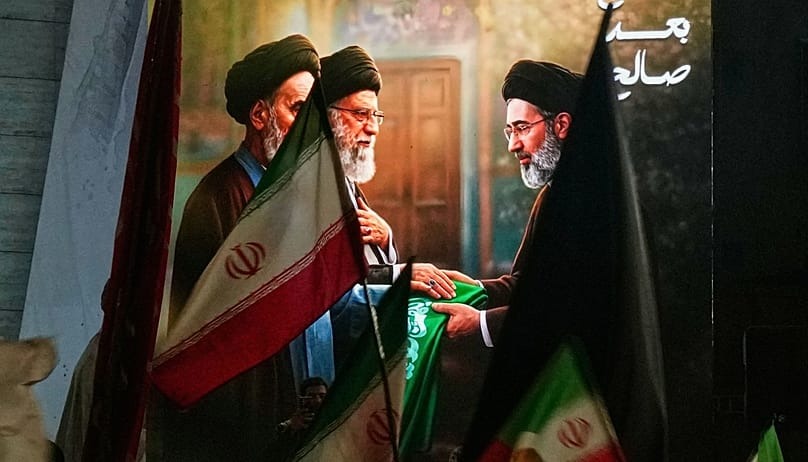
Protesters wave Iranian flags and hold a portrait of the late Iran’s Supreme Leader Ayatollah Ali Khamenei and his son Ayatollah Mojtaba Khamenei to support his selection as t AP Photo
Iran, which will mark next week the anniversary of the death of the Islamic Republic’s founder Ayatollah Ruhollah Khomeini, has still not held an official funeral or burial ceremony for its late leader Ali Khamenei.
His son and new Ayatollah Mojtaba Khamenei has remained out of public view since his father’s death on 28 February, with only written statements purportedly written by him being read on state-run media.
Diplomacy amid military incidents
The issue of transit through the Strait of Hormuz, one of the main pillars of Iran–US negotiations, has recently been the subject of multiple controversies.
While the number of vessels transiting this strategic waterway has increased, reports have emerged of sporadic exchange of fire between Iran and the US, particularly along Iran’s southern coast in the Persian Gulf.
Tehran has claimed on at least two occasions that it issued warning shots at vessels attempting unauthorised passage, and in one case claimed to have downed a US aircraft near Bushehr — an allegation denied by CENTCOM.
There have also been reports of strikes on southern Iranian ports including Bandar Abbas and Bushehr in recent days.
Tehran’s Friday prayers leader, Hojjatoleslam Seyyed Mohammad Hassan Aboutorabi-Fard, indirectly referred to these developments in Friday sermon.
“The United States, at dawn last Thursday, targeted a site near Bandar Abbas airport which caused neither human casualties nor material damage, but constituted an infringement on Iranian airspace and territory,” he said.
“At 4:50 am on Thursday, the Aerospace Force of the Islamic Revolutionary Guard Corps delivered a firm and decisive response. This sends a clear message of enhanced deterrence and a shift in the balance of power in Iran’s favour,” he added.
Meanwhile the Iranian negotiating team led by Mohammad-Bagher Ghalibaf, who was notably praised in Mojtaba Khamenei’s recent message, is said to be intent to find a pathway toward ending the war and reaching an agreement.
According to the latest analysis by the Washington-based Institute for War Studies think tank (ISW), it remains unclear to what extent the details of this process are accepted by Mojtaba Khamenei or by IRGC commander General Ahmad Vahidi.
The ISW also notes that Iran’s leader stated in his latest written message that the Islamic Republic will never give up on the issue of control over the Strait of Hormuz.
The IRGC is seeking to consolidate its control and management over traffic in this vital waterway, while US forces are attempting to prevent such a development.
According to a senior US official cited by CBS News, Iran had agreed in principle to open the Strait of Hormuz in exchange for a lifting of the US naval blockade.
The US Treasury Department has recently sanctioned Iran’s newly established body for managing the Strait of Hormuz and has threatened sanctions against any entity cooperating with it, including Oman.
Trump has also directly threatened US regional ally Oman — to which Iran’s Foreign Ministry responded by expressing solidarity with its southern neighbour.
Future scenarios
The ISW has two scenarios for control of the Strait of Hormuz: formal recognition of Iranian control through an international agreement or maintaining the status quo through threats or limited use of military force against transiting vessels.
However, the ISW emphasised that Iran’s attempt to impose high transit fees is unlikely to be sustainable if shipping companies’ risk tolerance does not change, and that, in the event of failed negotiations, military options may again be considered.
On the other hand, Ibrahim Azizi, head of the Iranian parliament’s National Security and Foreign Policy Commission, has stated that Tehran is pursuing “smart management of the Strait of Hormuz” and that this policy is permanent rather than temporary.
He also reiterated that Iran has no intention of removing enriched uranium from the country and transferring it to a third state — a proposal previously raised by Trump, who said Iran’s enriched uranium must either be transferred to the US for destruction or destroyed elsewhere in coordination with Tehran.