

Faced with renewed resistance from Hungary, the EU has been forced to change plans and now aims to unblock two, rather than five, accession clusters with Ukraine and Moldova before the summer break.
The European Union has scaled back its ambitions for Ukraine’s accession talks, now targeting the opening of just two negotiating clusters in July rather than five.
The revised timetable in Brussels aims at unlocking Cluster 6 (external relations) and Cluster 2 (internal market) before the summer break, several officials and diplomats told Euronews, with the remaining three tackled gradually afterwards.
Ukraine and Moldova, which are informally paired, opened Cluster 1 (fundamentals) earlier this month after a two-year wait under Hungary’s veto.
The change of plans comes as the new government in Budapest signalled several times, both publicly and privately, its opposition to speeding up Ukraine’s membership bid.
Hungary has yet to sign the joint letters necessary to unblock the different clusters. The refusal was confirmed on Tuesday during a working group meeting between member states, which left the process on hold for now.
Though largely procedural, the impasse underscores Hungary’s enduring reservations regarding Ukraine’s path to EU membership.
For Budapest, opening all six clusters in a condensed period is tantamount to fast-tracked accession. The characterisation is rejected by a majority of member states, which see the clusters as just the beginning of an arduous, complex journey.
“There are definitely issues, but we expect them to be resolved in time for at least two clusters to be opened in July,” an EU official with an overview of the file told Euronews.
Still, the climbdown marks a significant retreat for Brussels.
The European Commission has consistently indicated that Ukraine was technically ready to negotiate the six thematic clusters, which altogether cover 33 chapters.
Last month, Marta Kos, the European Commissioner for Enlargement, upped the ante and set July as the deadline to open all clusters, a target endorsed by Kyiv.
“Everything is ready,” Kos said.
But faced with renewed resistance from Hungary — and possibly other member states suspected of having used the previous veto to keep their own concerns under wraps — Brussels has been forced to lower its ambitions.
Commission President Ursula von der Leyen struck a positive tone after last week’s summit of EU leaders, but fell short of echoing Kos’s ambitious objective.
“Our goal is to open more clusters before the summer,” von der Leyen said.
By contrast, Ukrainian President Volodymyr Zelenskyy, who attended the summit in person, maintained the original ambition.
“We are ready to move further,” he told leaders. “We can open the other five clusters as well. Everything is already prepared, and this can be done in the coming weeks.”
If there is unanimity, the next cluster could be formally opened on 14 July during a meeting of European affairs ministers in Brussels.
Magyar puts his foot down
Momentum behind enlargement surged following the Hungarian elections in April and the sudden end of Viktor Orbán’s 16-year rule.
The newly elected prime minister, Péter Magyar, offered an olive branch by lifting the country’s longstanding veto on the first cluster in early June.
But Magyar has since signalled that he is unwilling to support a faster pace of negotiations.
Speaking to reporters after last week’s summit, Magyar said a section in the joint conclusions that spoke about opening all remaining clusters with Ukraine “as soon as possible” was deleted at his request. (Conclusions depend on consensus.)
“We removed a lot from the text to avoid any explicit suggestion that, now that the first cluster has been opened, all the others will suddenly be opened as well. We do not think that would be a good idea,” he told reporters.
Magyar framed his position partly as a defence of Western Balkans candidates — Montenegro, Albania, North Macedonia and Serbia — which have spent years and, in some cases, decades working towards membership.
“The first cluster has only just been opened — the ink is barely dry on the decision,” the prime minister said. “It also sends the wrong message to the Western Balkan countries that have spent years working towards EU membership. Some have even changed their names; others have rewritten large parts of their constitutions.”
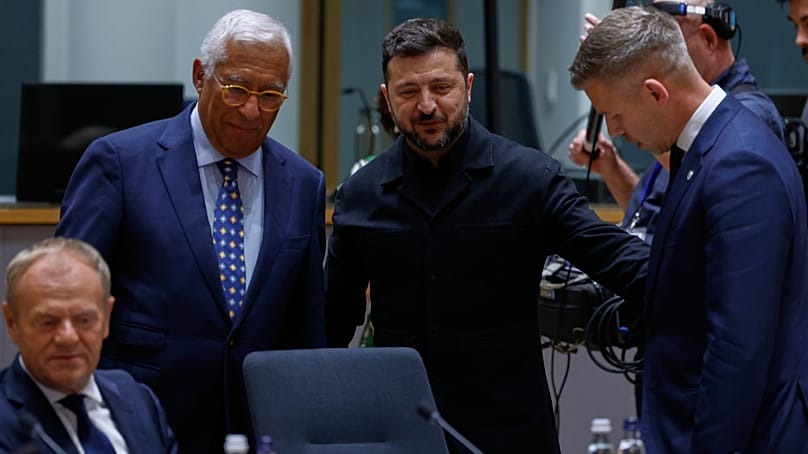
Peter Magyar met Volodymyr Zelenskyy at the EU summit. Associated Press.
Magyar later said that Hungary was not “the only one” that opposed unblocking all the clusters with Ukraine in July. He did not say which other countries resisted.
Meanwhile, Márton Hajdu, chair of the Foreign Affairs Committee of the Hungarian parliament, told Euronews that Kyiv first needs to work on the rights of the Hungarian minority in Ukraine, a recurring bone of contention between the two neighbours.
“There is no new Hungarian position in this,” Hajdu said.
“Hungary supported the opening of the first negotiation cluster with Ukraine and Moldova, and now we need to work on the reforms undertaken therein, including the agreement on the rights of the Hungarian community in Transcarpathia.”
Hajdu said that the enlargement was not a speed race but a merit-based, step-by-step process that must also remain credible for the Western Balkans.
“This is truly a complicated tango: we will only move forward if everyone keeps pace and no one steps on the other’s toes,” he added.
Magyar has repeatedly said that Hungary intends to hold a legally binding referendum over Ukraine’s membership once negotiations end.
The premier has suggested that the process could take 10 to 15 years to complete — a timeline that would likely be unacceptable to Ukraine.