

Germany’s right-wing Alternative for Germany (AfD) party won Sunday’s state election in Saxony-Anhalt with a record 43.8% of the vote but fell short of a majority to govern alone, while Chancellor Friedrich Merz’s conservative Christian Democratic Union (CDU) slumped to a historic low of 17.2%, according to preliminary official results.
The state election authority said all ballots had been counted. The AfD more than doubled its 20.8% result from 2021 and posted its strongest showing in any German state election. It won 39 of 83 seats in the Magdeburg parliament, three short of the 42 needed for an outright majority. With all other major parties ruling out a coalition with the AfD, the outcome pointed to political uncertainty and long talks on forming a government.
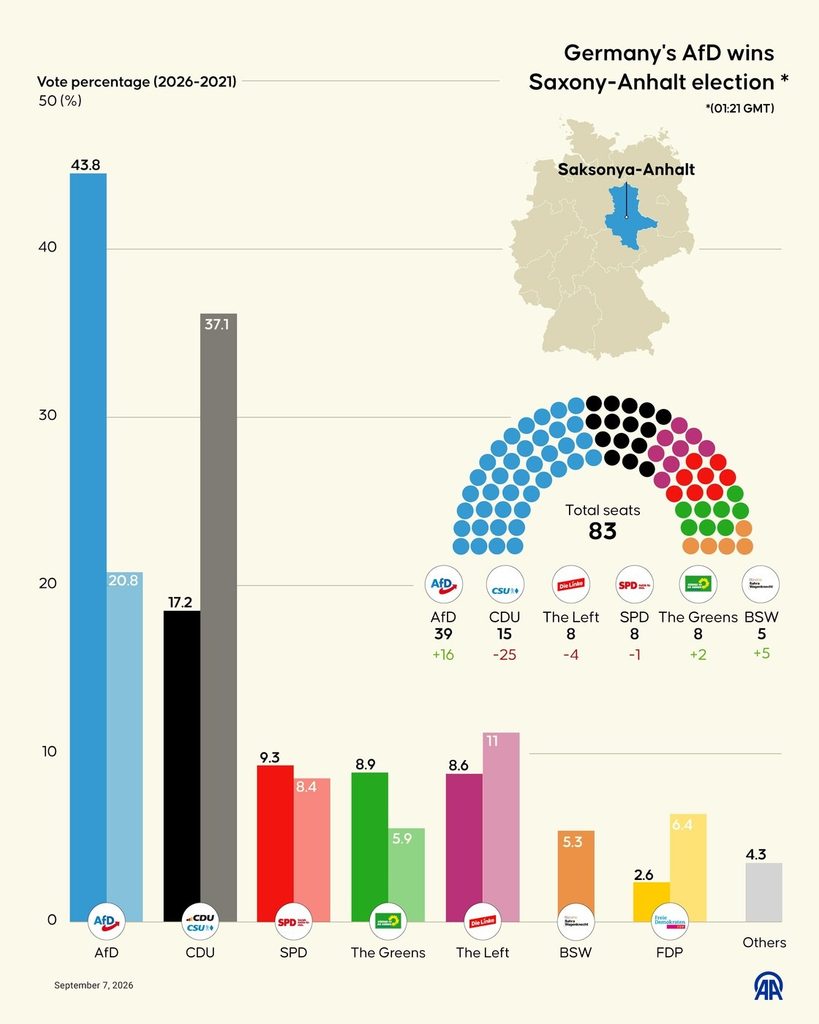
Turnout was 77.8%, up from 60.3% in 2021 and the highest in the state since German reunification.
“We have achieved exactly what we set out to achieve. We have made history in this country,” AfD lead candidate Ulrich Siegmund told public television.
He said cooperation was possible “only with those who support the AfD’s demand for a clear change in policy,” whether that came “through a parliamentary group or through individual deputies.” Asked what would happen if no partner emerged, he said: “If necessary, there will just be new elections.”
The Social Democrats (SPD) finished third with 9.3%, one of their weakest showings in the eastern state. The Greens followed with 8.9% and the socialist Left Party with 8.6%. The Sahra Wagenknecht Alliance (BSW) passed the 5% threshold with 5.3% and entered the new parliament. The Free Democrats, junior partners in the outgoing government, missed the threshold with 2.6%.
Merz’s CDU took 15 seats, down from 40 in 2021. The Greens, the Social Democrats and the Left Party won eight seats each, and the left-wing populist BSW won five. The other parties together hold 44 seats.
The numbers offer no clear path to a governing majority. A coalition of the CDU, SPD and Greens would hold 31 seats. Adding the Left Party would lift that bloc to 39, still short of 42. The AfD could reach a majority only with BSW support. The BSW could back an AfD candidate, support a CDU-backed contender or abstain. In a third ballot for state premier, only a plurality is required.
Party leaders are expected to set out their positions this week, with initial exploratory coalition talks likely to begin in the coming days.
Germany’s domestic intelligence agency has classified the AfD’s regional branch as a proven right-wing extremist organization, saying parts of the party promote a racist, ethnic understanding of national identity that is incompatible with the country’s democratic constitutional order. Mainstream parties have cited that assessment in maintaining a refusal to govern with the AfD.