

Nigeria’s Dangote refinery announced on Monday that it intends to give priority to the local fuel market in an effort to reduce shortages and cushion the effect of the ongoing Middle East conflict on prices.
The company, however, cautioned that this commitment depends largely on continued government backing and noted that additional fuel price increases cannot be completely ruled out.
Over the past week, petrol prices in the West African nation have already climbed by about 20 percent following military strikes by the United States and Israel on Iran, as well as Iran’s retaliatory actions.
The conflict has disrupted supply routes from the Middle East, pushing global benchmark crude oil prices beyond $100 per barrel on Monday. This development has triggered declines in international stock markets and raised concerns about potential fuel supply shortages.
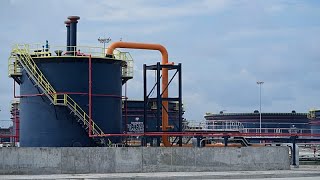
Owned by Africa’s richest businessman, Aliko Dangote, the Dangote refinery currently has the capacity to process 650,000 barrels of crude oil per day and is capable of meeting Nigeria’s fuel demand as Africa’s top oil producer.
Prior to the start of operations at the refinery in 2024, Nigeria relied heavily on imported petroleum products, which frequently led to supply shortages across the country.
Speaking at a media briefing in Lagos on Monday, refinery Managing Director David Bird assured that the country’s fuel supply would remain stable.
Bird added that this assurance depends on the refinery’s ability to continue receiving Nigerian crude oil with the cooperation of the government and the Nigerian National Petroleum Company, even if the crude is priced according to international market rates.
The Nigerian National Petroleum Company is entirely owned by the government.
He also acknowledged that future price hikes cannot be ruled out because the Dangote refinery operates as a private company and is therefore directly affected by fluctuations in the global commodities market.
According to Bird, the refinery’s operating costs have been significantly impacted by the rise in crude oil prices globally, along with higher transportation and insurance expenses.
He further explained that any efforts to stabilise fuel prices would ultimately fall under the responsibility of the government.
He emphasised that government intervention would be required if authorities decide to step in and manage energy costs within the economy.
Meanwhile, petrol prices in Nigeria surged this week from 830 naira per litre in Lagos to a record 1,050 naira (about $0.59 to $0.75). At the beginning of 2023, the pump price stood at just 195 naira per litre.
Shortly after assuming office in 2023, President Bola Tinubu removed the long-standing fuel subsidy programme that had kept petrol prices artificially low for years.