

Palestinians have started moving through the Rafah border crossing between the Gaza Strip and Egypt after it reopened for pedestrian travel.
The crossing has been largely closed since May 2024, when Israeli forces took control of the Gazan side. Its reopening was originally scheduled as part of the first phase of US President Donald Trump’s ceasefire plan between Israel and Hamas, which began in October 2025. However, Israel delayed the reopening until the return of the body of the last Israeli hostage in Gaza, which occurred last week.
The reopening provides a crucial lifeline for many Palestinians, though restrictions remain: only limited numbers of people, and no goods, are currently allowed through. Local hospitals and the World Health Organization report that around 20,000 sick and wounded Palestinians are awaiting evacuation for medical treatment. Israeli authorities say just 50 patients, accompanied by one or two relatives, will be permitted to exit each day, while another 50 individuals who left Gaza during the war can return.
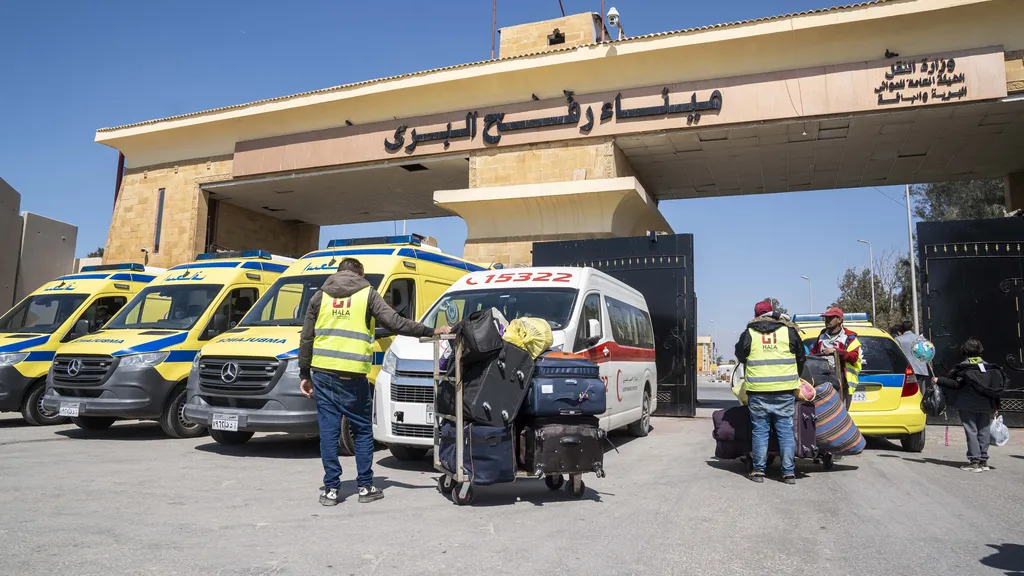
Operations at the crossing will be overseen by European Union supervisors and local Palestinian staff, while Israel will conduct remote security checks. On Monday morning, an Israeli security official confirmed that the Rafah crossing had “now opened to the movement of residents, for both entry and exit,” following the arrival of the European Union Border Assistance Mission (EUBAM) teams.
Egyptian sources reported that the first group of Palestinians returning from Egypt to Gaza had already crossed, part of efforts to facilitate movement.
Among those hoping to travel is Palestinian mother Sabrine al-Da’ma, who intends to donate a kidney to her 16-year-old daughter, Rawa, who suffers from kidney disease. She described the urgency of their travel, noting that her daughter’s condition has worsened due to the war, hunger, and limited food access.
A trial opening of the crossing was conducted on Sunday, with around 30 Palestinian staff members stationed at the Egyptian side in preparation for the operational phase. The WHO is managing patient transfers from Hamas-controlled areas, transporting them by bus to the crossing across the so-called “Yellow Line” into Israeli-controlled territory.
According to Trump’s 20-point Gaza peace plan, the Rafah crossing is to operate under the same mechanisms established in a previous ceasefire deal in January 2025. Before its seizure by Israel in 2024, Rafah was the main exit point for Palestinians and a key entry route for humanitarian aid; currently, aid entering from Egypt is redirected through Israel’s Kerem Shalom crossing.
More than 30,000 Gazans have registered with the Palestinian embassy in Cairo to return to Gaza. The crossing’s opening had been delayed by Israel’s condition that Hamas first hand over the body of the last deceased Israeli hostage, Master Sgt Ran Gvili, retrieved last week. Gvili was one of 251 people abducted by Hamas and its allies during the October 7, 2023, attack on Israel, which killed around 1,200 people.
Since the Israeli military campaign in response to the attack began, over 71,790 Palestinians have been killed, according to Gaza’s Hamas-run health ministry.