

Founder and Chairman of Groupe Nduom, Dr Papa Kwesi Nduom, has called for any sale of Standard Chartered Bank Ghana’s retail banking business to be reserved for an indigenous Ghanaian company, arguing that the country’s financial sector should create greater opportunities for local ownership.
In a brief but pointed post on his official Facebook page on Friday, June 26, Dr Nduom urged policymakers and regulators to ensure that local investors are given priority should the multinational bank proceed with plans to divest its retail operations.
“Make no mistake about this: if Standard Chartered is selling its retail banking business, the buyer should be an indigenous Ghanaian company.”
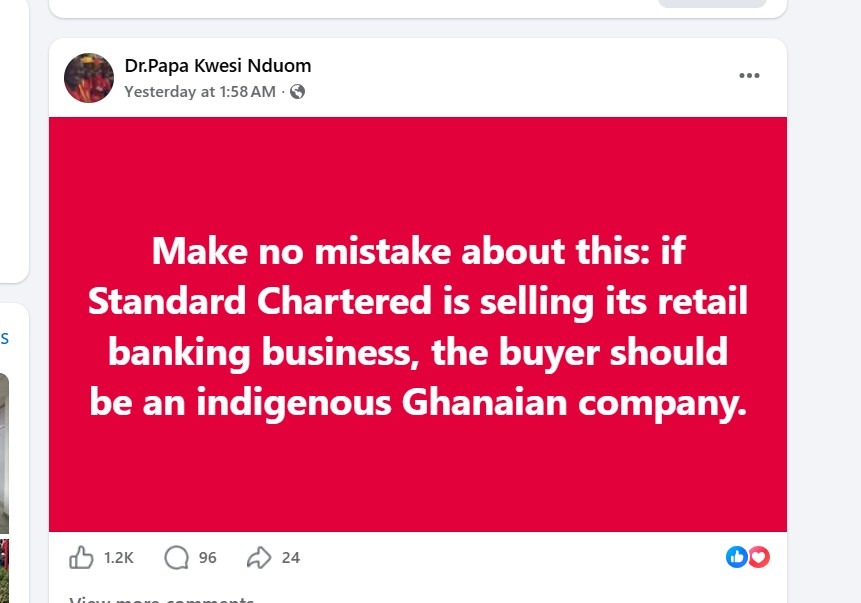
Although he did not elaborate on his position, the comment is expected to rekindle debate over indigenous participation in Ghana’s banking industry and the extent to which local firms should be prioritised when major foreign-owned financial institutions restructure or divest parts of their operations.
The intervention comes amid reports that Standard Chartered is reviewing aspects of its global business strategy, including its retail banking operations in selected markets, although no official announcement has been made regarding a sale of its Ghanaian retail business.
Dr Nduom’s remarks also come at a time when discussions about local ownership in the financial services sector continue to gain prominence following the banking sector reforms and consolidation exercise undertaken by the Bank of Ghana in recent years.
The businessman and former presidential candidate has remained an outspoken advocate for indigenous enterprise.
His comments are likely to resonate with stakeholders who argue that Ghanaian-owned financial institutions should be given greater opportunities to expand their footprint and compete with multinational banks.
The statement is particularly noteworthy given Dr Nduom’s own recent legal victory in the long-running dispute over the revocation of the licence of GN Savings and Loans.
A court recently ruled in favour of restoring the institution’s licence, a development widely viewed as a significant milestone in the protracted legal battle arising from Ghana’s financial sector clean-up.
If Standard Chartered eventually decides to dispose of its retail banking operations in Ghana, any transaction would require regulatory approval from the Bank of Ghana and would likely attract interest from both local and international financial institutions.