

Oil prices dropped sharply after US President Donald Trump indicated that the conflict in Iran could end “very soon.”
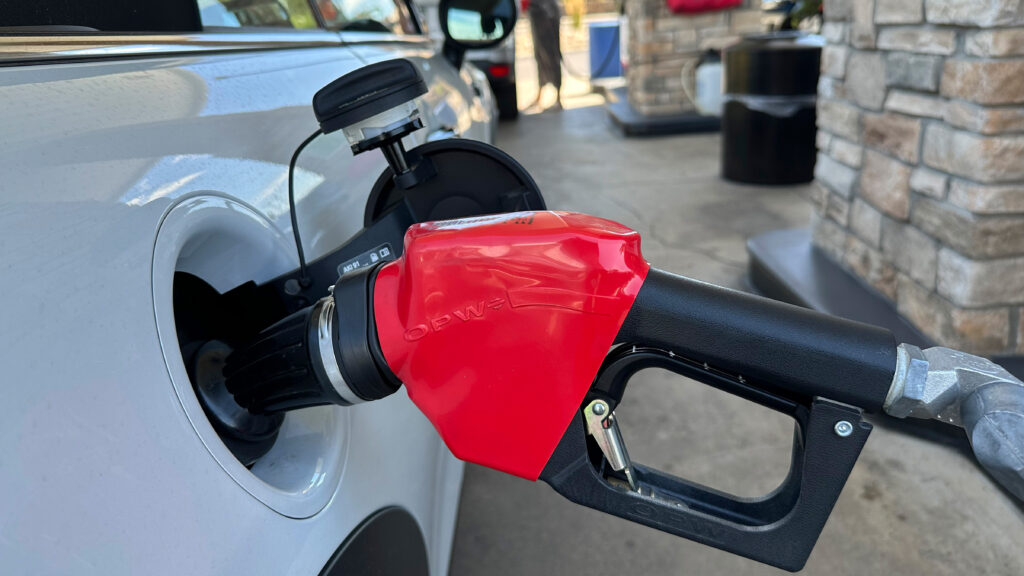
Crude had surged to nearly $120 a barrel on Monday amid fears that the war would severely disrupt energy supplies from the Middle East, but it fell back to around $93 following Trump’s remarks.
Although prices remain substantially above pre-conflict levels, stock markets rebounded, with London’s FTSE 100 opening up 1.3%.
Trump stated that he believed “the war is very complete, pretty much,” but he also warned Iran against blocking the Strait of Hormuz, a vital shipping route for global oil and gas.
“If Iran takes any action that disrupts oil flow through the Strait of Hormuz, the United States will respond TWENTY TIMES MORE FORCEFULLY than before,” he wrote on social media.
In response, the Islamic Revolutionary Guard Corps said that Iran’s armed forces would “not allow a single litre of oil to be exported from the region,” describing Trump’s statements as “nonsense.”
Earlier in the day, Trump told reporters in Florida: “We took a small operation because we felt it was necessary to remove some evil. I think you’ll see this will be a short-term mission.”
During Asian trading, Brent crude briefly fell below $84 per barrel before rebounding to $93.76, while US West Texas Intermediate (WTI) declined 4% to $90.96 a barrel.
Gas prices also eased, with UK month-ahead delivery rates dropping more than 10% to 123p per therm, down from Monday’s high of 171p.
Alberto Bellorin of InterCapital Energy said the fall in oil prices provided traders a chance to “exhale,” but he warned that energy markets remain in a “total tug-of-war.”
“Oil trading will stay highly sensitive,” he added, noting that prices could spike again if the conflict intensifies or drop further if tensions ease.
Equity markets in Asia gained as concerns over the economic impact of the war moderated. Japan’s Nikkei 225 rose 2.9%, recovering some of Monday’s losses, while South Korea’s Kospi climbed 5.4%.
Markets had been hit hard the previous day due to fears that Gulf disruptions could push up inflation and interest rates.
The Strait of Hormuz remains crucial to global energy flows, with roughly one-fifth of the world’s oil passing through the narrow channel. Shipping has nearly halted since the outbreak of conflict more than a week ago.
Amin Nasser, CEO of Saudi Aramco, the world’s largest oil exporter, warned of “catastrophic consequences” if the passage remains blocked. He noted that global oil stocks are at five-year lows and the supply disruption is causing reserves to deplete faster.
“The longer the disruption continues, the more severe the effects on the global economy,” Nasser said.
While oil prices have retreated from Monday’s peak, they are still around 20% higher than before the US and Israeli airstrikes on Iran, according to Park Kee Hyun of the S Rajaratnam School of International Studies. He added that volatility will persist, as suppliers may charge premiums to offset risk.
Trump’s statements suggest a potential end to the conflict, but analysts caution that actual developments on the ground will determine whether markets truly stabilize.
G7 nations on Monday indicated readiness to take “necessary measures” to ensure global energy supplies amid the surge in oil prices.
A G7 meeting with the International Energy Agency (IEA) did not produce a decision on releasing strategic reserves, though the option was discussed.
Robin Mills, CEO of Dubai-based consultancy Qamar Energy, told the BBC that using reserves too early is undesirable: “Once strategic stocks are released, they’re gone. If the war is indeed over, as Trump suggests, there’s no need to tap them. But if disruption continues, now might be the right time to ease the market.”
UK Chancellor Rachel Reeves said the UK urged “immediate de-escalation” at the G7 meeting and guaranteed security for vessels in the region.
“I am ready to support a coordinated release of IEA oil reserves,” she added.