

A striking blood-red moon will appear in the skies during a total lunar eclipse on Tuesday, offering skywatchers across several continents a rare celestial spectacle. Unfortunately, viewers in Africa and Europe will miss out, but residents of other regions can enjoy the full show.
On Tuesday morning, North America, Central America, and western South America will witness the total lunar eclipse. Later in the day, Australia and eastern Asia will catch the event. Meanwhile, partial stages of the eclipse, where the moon appears to have small “bites” taken out of it, will be visible from Central Asia and much of South America.
Eclipses, both solar and lunar, occur when the sun, Earth, and moon align perfectly. NASA notes that between four and seven eclipses happen each year, often occurring in close succession. Tuesday’s lunar eclipse follows just two weeks after a dramatic “ring of fire” solar eclipse seen in Antarctica.
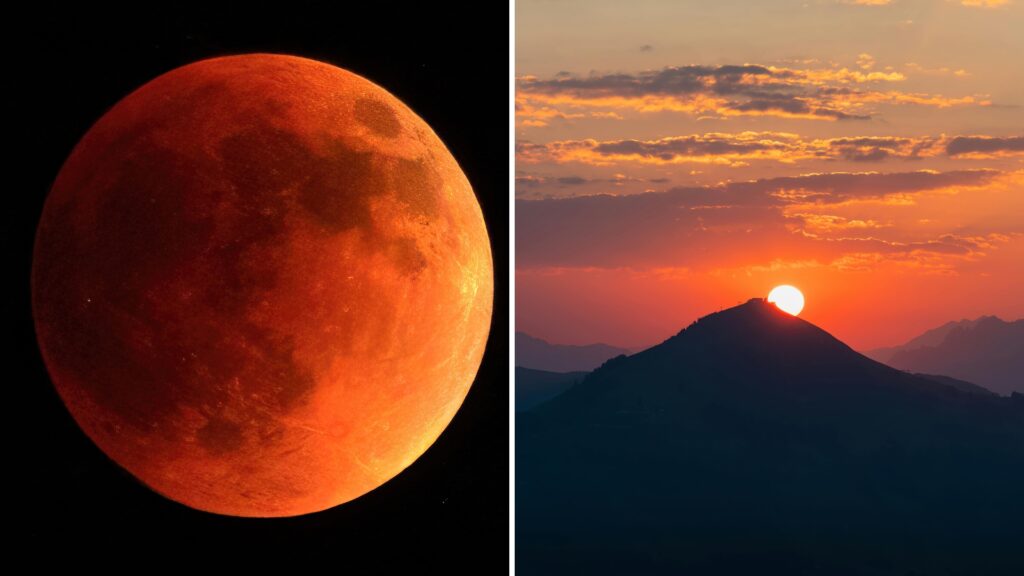
During a total lunar eclipse, the Earth moves directly between the sun and the full moon, casting its shadow over the lunar surface. The moon appears red, commonly called a “blood moon,” because sunlight is filtered and bent through Earth’s atmosphere.
Dhara Patel, a space expert at the UK’s National Space Centre, explains: “The moon isn’t getting direct sunlight because Earth blocks it. But sunlight passing through Earth’s atmosphere bends, and red light is redirected onto the moon, giving it that reddish-orange hue.”
The eclipse lasts several hours, with totality the phase when the moon is deepest in Earth’s shadow lasting about an hour. No special equipment is needed to observe the event; a clear view of the sky is enough. Patel advises simply going outside and watching as Earth’s shadow slowly darkens the moon, reaching its reddest moment at maximum eclipse.
For precise timing, viewers can use forecasting apps or online celestial calendars. Observers are encouraged to check the sky multiple times during the night to enjoy the full progression.
Looking ahead, a partial lunar eclipse is expected in August, which will be visible across the Americas, Europe, Africa, and western Asia.