
Trump signed an initial framework deal to restore the pre-war status quo between Iran and the United States, inking an initial agreement towards ending a war he started with Israel on 28 February.
US President Donald Trump signed an agreement with Iran on Wednesday that calls for Tehran to dilute its stockpile of highly enriched uranium and waives US-backed sanctions on the country, immediately allowing Iran to sell its oil freely in a major concession from Washington, according to details released by both countries.
The initial deal to end the war takes “immediate effect” after leaders from both countries signed it, Pakistani Prime Minister Shehbaz Sharif, who helped mediate the agreement, said in a post on social media.
The agreement calls for a permanent end to hostilities and starts a 60-day negotiating clock to reach a final deal on the future of Iran’s nuclear programme, though Trump left the door open to resume attacks. It also appears to offer Iran several benefits up front while extracting little in return.
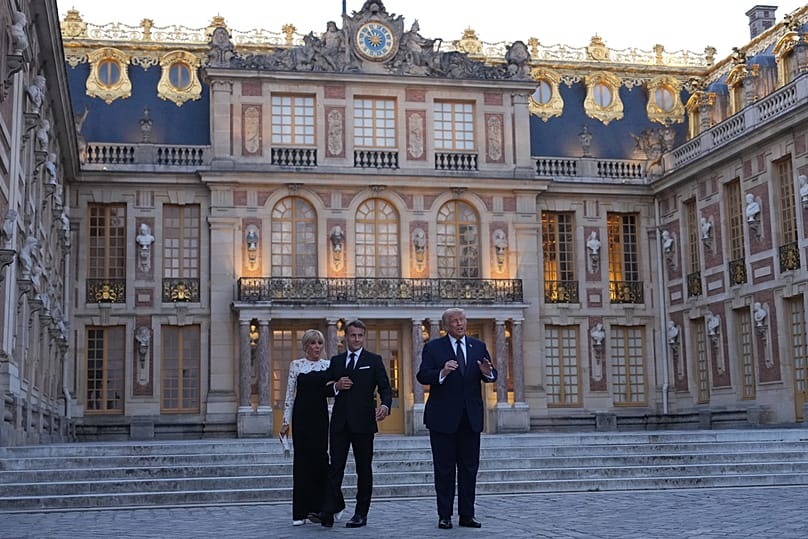
Trump greeted by French President Emmanuel Macron and and first lady Brigitte Macron as he arrives at the Palace of Versailles, Wednesday, June 17, 2026, in Versailles, France Julia Demaree Nikhinson/Copyright 2026 The AP. All rights reserved.
The deal has been shrouded in secrecy and confusion for days. US officials refused to disclose the terms even after saying Trump and Vice President JD Vance digitally signed it over the weekend.
Trump signed a physical copy on Wednesday while dining with French President Emmanuel Macron at Versailles, the palace where many historic agreements have been signed over the centuries, ending wars or territorial disputes.
The White House had planned a signing ceremony on Friday in Switzerland, but its fate is now uncertain, with conflicting information emerging from the US, Iran and Pakistan.
“It’s signed,” Trump said as he left the dinner at Versailles, which followed his trip to the Group of Seven summit in France.
In a video posted online by a White House aide, Trump was seen seated at a table next to Macron signing a paper copy of the agreement. Trump then handed the document and pen to Secretary of State Marco Rubio as people in the room applauded.
“This was not easy,” Trump said right before he signed it, according to a video posted to social media by Macron.
In Tehran, a stone-faced President Masoud Pezeshkian signed the deal on behalf of Iran, according to the state-run IRNA news agency, which posted an image of him holding up the deal with his signature and Trump’s.
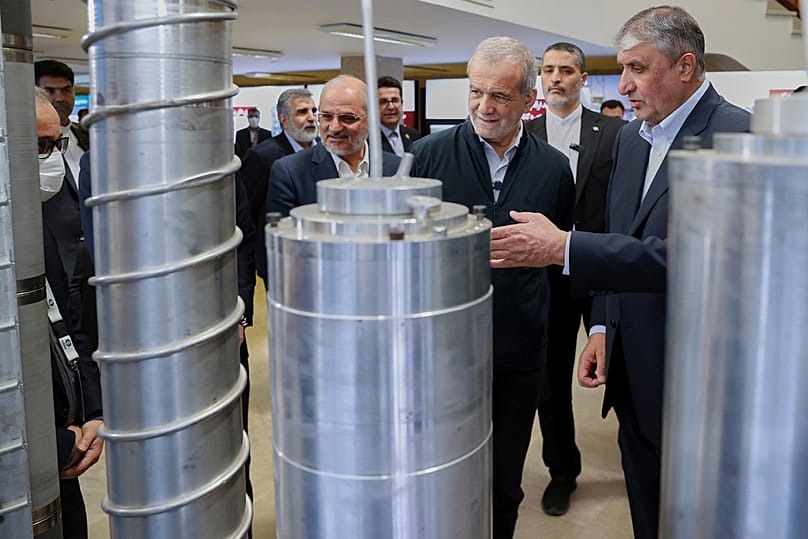
FILE – President Masoud Pezeshkian listens to head of Atomic Energy Organization of Iran as he visits an exhibition of Iran’s nuclear sector, in Tehran, Iran, April 9, 2025 Iranian Presidency Office via AP/Iranian Presidency Office via AP
The contents of the deal have not been released by US officials to the public, but some reports leaked to US media appear to show the White House having agreed to major concessions to get the deal on the table, despite previously displaying a hardline rhetoric against the Islamic Republic.
Much of the agreement would restore the status quo before the war, including ending hostilities, restarting talks between the US and Iran over Tehran’s nuclear project, and reopening the Strait of Hormuz, the crucial passage for the world’s oil and natural gas whose closure created a historic global energy crisis.
The agreement opens the strait without tolls for two months, allowing the resumption of a fifth of the world’s oil and gas supplies, but does not preclude fees in the future, according to the drafts from both countries.
In return, the US will move to waive, but not eliminate, some wide-ranging sanctions against Iran.
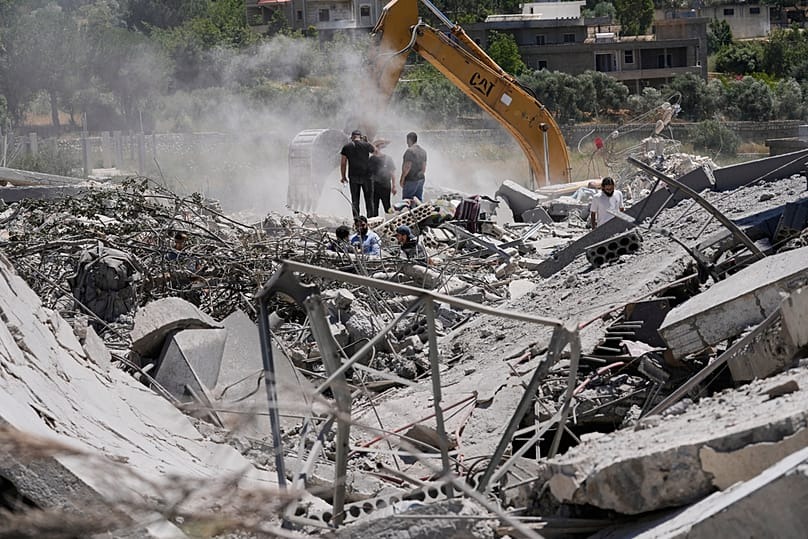
People use an excavator as they search for dead bodies under the wreckage of a destroyed house in the southern village of Touline, Lebanon, Tuesday, June 16, 2026 Mohammed Zaatari/Copyright 2026 The AP. All rights reserved
The deal also affirms a commitment to Lebanon’s territorial integrity in the face of Israel’s invasion and continued aggression as they look to target Hezbollah positions, despite an ongoing fragile truce.
That is one of the most delicate parts of the agreement because Israel has maintained that it will continue to “defend itself” and to occupy vast swaths of Lebanon. Iran has repeatedly demanded Israel to withdraw under the deal, a condition Tel Aviv has already rejected.
The US and Israel went to war 28 February in part to prevent Iran from acquiring a nuclear weapon. Trump has cited various goals for the war, including at times vowing it would end Iran’s nuclear and missile programmes and its support for Hezbollah and other proxy groups in the region. He also suggested it could lead to toppling the Iranian government.
The interim deal falls short of all those goals, but Trump hailed it as “very strong.”
The Republican president has marketed the deal as a show of goodwill from the White House to negotiate a long-term agreement in good faith, but he also opened the door to abandoning it if need be.
“It’s a memorandum of understanding, and if I don’t like it, we’ll go back to shooting at them, dropping bombs,” said a defiant Trump in Paris.