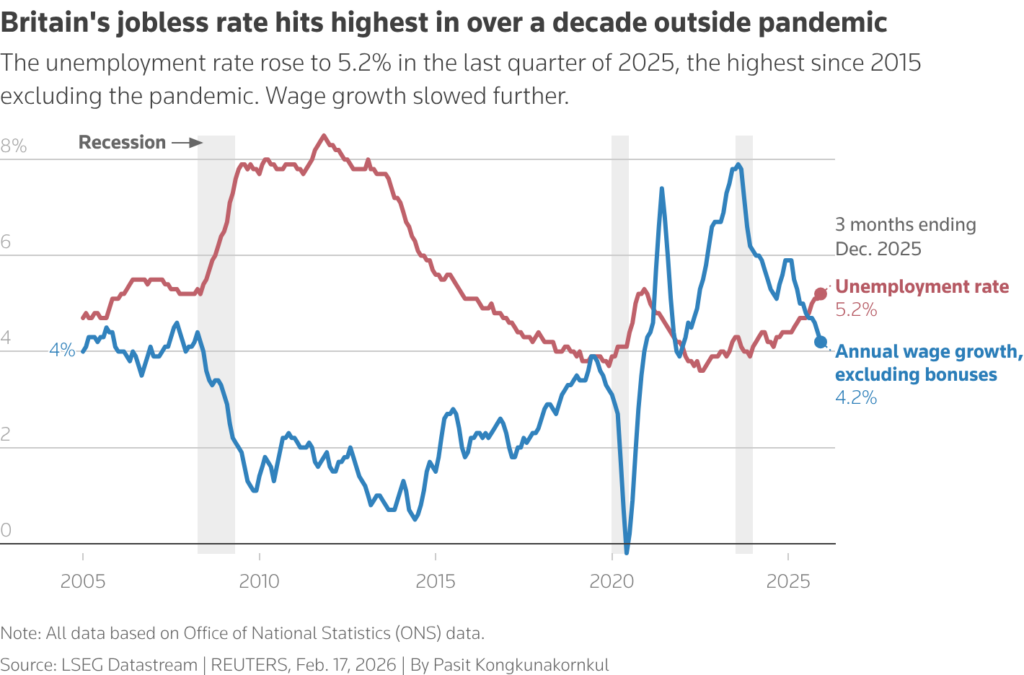
Britain’s unemployment rate climbed to its highest level in more than a decade outside the pandemic years, while wage growth eased further, according to data released on Tuesday strengthening expectations of an interest rate reduction by the Bank of England next month.
The jobless rate rose to 5.2% in the three months to December 2025, the highest since 2015 when excluding the COVID-19 period, during which it reached 5.3%. This marked an increase from 5.1% recorded in the previous three-month period ending in November, figures from the Office for National Statistics showed.
The unemployment measure is based on a labour force survey currently being restructured after participation levels fell sharply during the pandemic. Analysts note, however, that data reliability has improved in recent months.
Business groups said the figures reflect the strain on the labour market following policy adjustments by Prime Minister Keir Starmer, including last year’s increase in employer taxes.
The pound briefly dropped by more than half a cent against the dollar before regaining part of the decline. Financial markets raised the probability of a quarter-point rate cut in March to about 80%, up from 65% the previous day.
ING economist James Smith said the latest employment figures keep the central bank firmly positioned for a March rate reduction.
Annual pay growth excluding bonuses slowed to 4.2% in the final quarter of 2025, down from 4.4% in the preceding period and in line with economists’ expectations in a Reuters survey. In the private sector, closely monitored by policymakers, wage increases moderated to 3.4% from 3.6%. The cooling in earnings may provide reassurance to the Bank of England that inflationary pressures linked to the labour market are easing.
The employment landscape has softened since Finance Minister Rachel Reeves raised employer-paid taxes last April. Companies are also grappling with an upcoming rise in the minimum wage and the financial implications of reforms designed to strengthen worker protections.
A recent survey indicated that more than a third of employers intend to scale back permanent hiring due to rising costs tied to the legislation. Alex Hall-Chen of the Institute of Directors said businesses have repeatedly warned about the potential hiring impact of the reforms but feel their concerns have not been fully addressed.
Economists highlighted an increase in youth unemployment, suggesting firms may be hesitant to recruit younger workers amid higher payroll expenses and broader economic uncertainty. Jack Kennedy, senior economist at Indeed, noted that companies are operating in a challenging climate marked by elevated employment costs, fragile confidence, and unclear growth prospects, leading many to curb junior hiring.
Nonetheless, there were signs that conditions may be stabilising. Payroll employment in December declined by a revised 6,000—far less severe than initially estimated and the smallest decrease since August. A preliminary reading for January showed an 11,000 drop. Meanwhile, job vacancy levels remained broadly steady, according to the statistics office.