

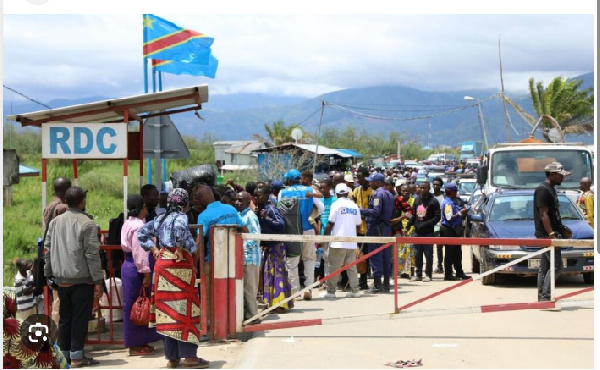
After being closed for over two months, the border linking the Democratic Republic of the Congo (DRC) and Burundi reopened on Monday, February 23, bringing an end to a period of uncertainty and isolation for thousands of locals.
In Uvira, a key city on the shores of Lake Tanganyika, daily life is slowly resuming.
The border had been shut following the capture of Uvira by the AFC/M23 amid heightened security concerns. Early Monday morning, crowds gathered at the Kavimvira crossing on the Congolese side and at Gatumba in Burundi, eager to cross after weeks of separation.
Merchants, transport workers, students, and families affected by the crisis were finally able to return, showing visible relief. Motorcycle taxis returned to the streets, bicycles laden with goods reappeared, and cross-border commerce — Uvira’s economic lifeline — restarted.
“I am extremely happy. For so long, we were stuck and could not go home,” said Dalili Mussa, a Congolese who had been stranded in Burundi during the closure.
Many families had fled across the border seeking safety from conflict. The United Nations High Commissioner for Refugees (UNHCR) reported that the advance of M23 rebels in South Kivu forced a large number of Congolese to seek refuge in Burundi. The border’s reopening now allows for gradual repatriation.
Aline Safi, another Congolese refugee, recalled the chaos: “We were at home with the children when gunfire and explosions began. We decided to escape to Burundi to avoid becoming casualties.” Today, she is able to return to Uvira, hoping to rebuild her life.
During the more than two-month closure, the local economy suffered heavily. Uvira relies on informal trade and daily exchanges with Gatumba. The suspension of traffic caused price hikes, shortages of essential goods, and significant income losses for households.
“The border reopening is a great relief for us and all the residents of Uvira,” said Bosco Amani, a local trader. “Even in Gatumba, people are celebrating. Motorcycles and bicycles are moving again. I saw students leaving their schools to join the celebration at the border.”
The reopening, announced the day before by South Kivu’s governor, is both a symbolic and economic milestone for the region. Yet, despite the celebrations, residents remain cautious. Scars from recent clashes are still visible, and security remains fragile.
For many in Uvira, the priority is that the border stays open and that both Congolese and Burundian authorities maintain safety and freedom of movement. As people once again cross at Kavimvira, a renewed sense of hope emerges, signaling the city’s slow return to normal life.