

In Kigali, the steady rhythm of construction masks the faint sounds of farmers’ hoes striking the soil on a chilly morning, as new measures aim to safeguard the country’s remaining agricultural land amid rapid urban expansion in Africa’s most densely populated nation.
Mukarusini Kurisikira, 84, had farmed her family’s land before fleeing to Congo during the 1994 genocide. Upon her return, she found that much of her hillside property had been taken for construction. She pointed to the city’s towering buildings as evidence.
Today, she cultivates maize and sweet potatoes on a plot no larger than a small house, barely enough to feed herself. “It is all I have,” she said, watching nearby construction equipment warily. Thanks to recent initiatives, she now has some protection for her small farm.
Since September, the Rwandan government has been systematically mapping agricultural land and employing satellite imagery to monitor any encroachment by developers on farmland and forests. This effort comes as the population is projected to reach 22 million in the near future.
The government’s aim is to strengthen food security amid rising costs of farm inputs like fertilizer, driven higher by global disruptions such as the war in Iran. Developers caught encroaching on farmland can face fines of up to $3,000 and prison sentences of up to six months.
Some unauthorized buildings in Kigali have already been demolished, though those connected to the structures remain tight-lipped for fear of government reprisals. Authorities now plan to add drones to improve real-time surveillance.
According to city land-use data, Kigali’s master plan has allocated nearly 22% of urban land to agriculture. Officials acknowledge that construction is lucrative due to demand but maintain that future projections indicate farming can still be productive.
With food demand rising, authorities believe innovative techniques can make small plots highly productive. Although most of Kigali’s food currently comes from other districts, farmland there is also shrinking, explained Emma-Claudine Ntirenganya, a spokeswoman for the mayor’s office.
Last year, the government published maps identifying areas designated for construction and others reserved for agriculture across Rwandan districts. Ntirenganya emphasized that urban agriculture can thrive in the city, showing residents that farming is feasible even in densely populated areas.
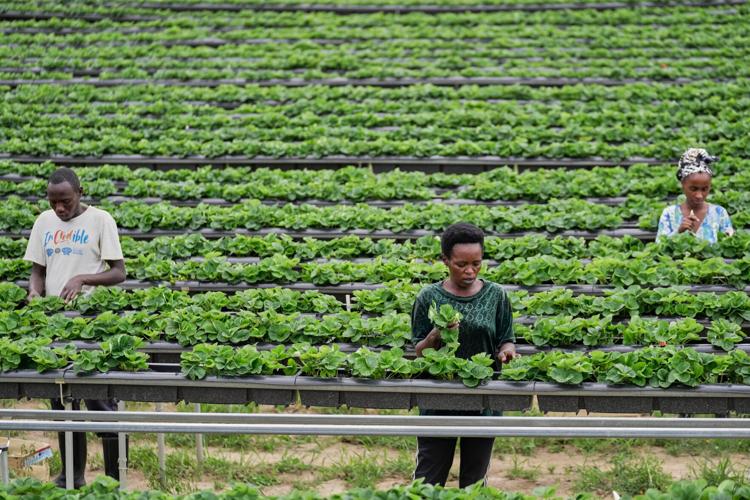
The city administration is establishing a rooftop greenhouse and requires developers to incorporate green spaces and gardens in new building plans. Vertical farming has emerged as another solution, with fruits and vegetables like strawberries grown in stacked containers. Christian Irakoze, co-founder of Eza Neza (“grow well”), described these urban farms as scalable and modular.
The AP visited two residential vertical farms and a third supplying a local grocery store. One farm had 600 plants arranged in vertical rows extending 50 meters along a perimeter wall. Irakoze highlighted this approach as a shift from traditional large-scale rural farming to smaller, adaptable urban solutions.
Using local inputs such as manure and volcanic sediment instead of commercial soil, he emphasized the need for self-reliance and locally sourced solutions. “We have to find ways to adapt, whether through seeds or fertilizers. Global events remind us that alternatives are essential,” he said.
Elsewhere in Kigali, young agronomists are training farmers in hydroponics, which uses water instead of soil to maximize yield. “As our population grows and land does not, we need innovative solutions to help farmers produce more,” said agronomist Richard Bucyana.
Bucyana added that Rwanda’s strategies can buffer against global shocks, advocating for African governments to pursue self-sufficiency. “Countries should begin thinking about how they can sustain themselves independently,” he said.