

Aliko Dangote, chairman of the Dangote Group, has leveraged top-level engagements in Washington to advocate for stronger investment in Nigeria’s energy and industrial sectors, cautioning that longstanding foreign influences continue to hinder Africa’s economic progress.
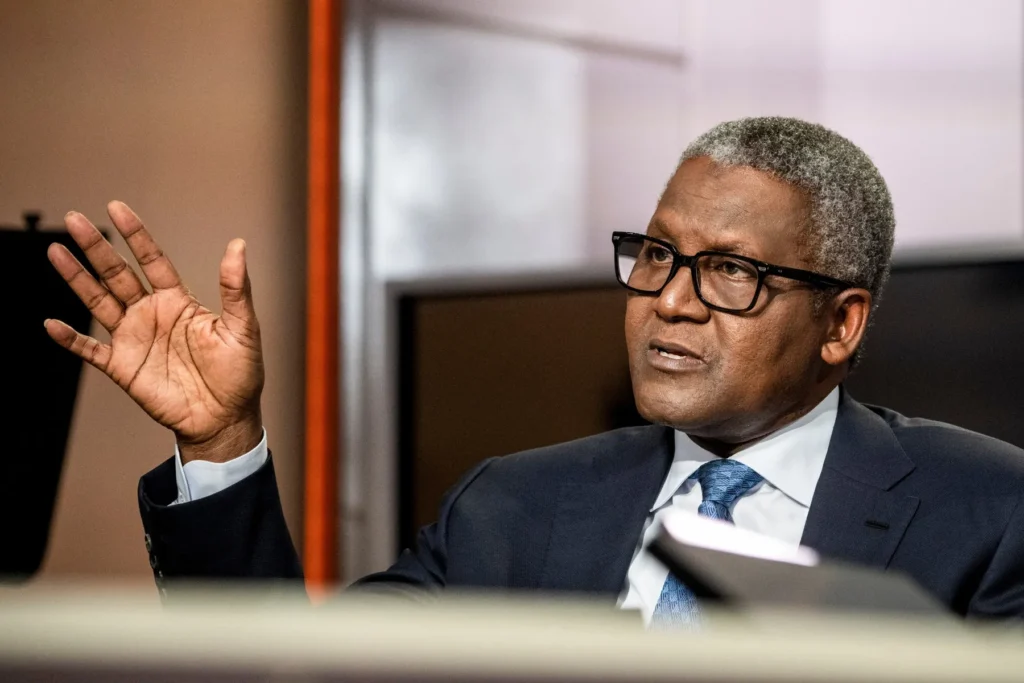
During the IMF and World Bank Spring Meetings, Dangote held talks with key global financial figures, including World Bank Group President Ajay Banga, IMF Managing Director Kristalina Georgieva, and John Jovanovic of the U.S. Export-Import Bank.
The company stated that the discussions focused on mobilising funding for infrastructure, boosting trade, and encouraging private sector-driven growth in Nigeria and across the continent.
These meetings come at a crucial time for Nigeria’s energy industry. In March 2026, the country became a net exporter of petrol for the first time in decades, largely due to production from the Dangote Petroleum Refinery.
Figures from energy analytics firm Kpler show that exports reached roughly 44,000 barrels per day during the month, slightly surpassing imports and creating a small surplus.
This development represents a major turnaround for a nation that has long relied on fuel imports, highlighting the increasing importance of local refining capacity in transforming regional energy dynamics.
Dangote aims to capitalise on this progress through a long-term blueprint known as “Vision 2030,” which seeks to boost output across refining, fertiliser production, and other industrial activities. Plans include raising refinery capacity from 650,000 barrels per day to 1.4 million barrels per day, positioning it among the largest globally.
The group also plans to expand fertiliser production from three million tonnes annually to 12 million tonnes, alongside further investments in cement, food processing, infrastructure, and digital assets such as data centres.
Beyond expansion, Dangote stressed that Africa’s development challenges extend beyond financing and are deeply rooted in structural issues. Speaking at the “Investing in Africa Forum,” he highlighted weak regional integration as a major concern.
He noted that while the African Continental Free Trade Area holds promise, its success depends on the effectiveness of regional markets, which he believes are currently underperforming.
Dangote further argued that external interests have historically slowed the continent’s industrialisation, pointing to the limited number of functional refineries across Africa as evidence of these constraints.
While recognising the role of foreign investment, he emphasised the need for Africans to take the lead in driving investment and reducing perceived risks. He explained that international investors often remain cautious, making it essential for local players to demonstrate confidence in the continent’s potential.
His remarks align with ongoing discussions among policymakers and investors on how to unlock domestic capital in emerging markets, especially as global financing conditions become more restrictive.
Dangote also pointed to missed opportunities in value addition, using Zambia’s copper exports as an example of raw materials being exported without local processing. He argued that strengthening industrial capacity within Africa could help retain more economic value.
In addition, he played a key role in global development conversations by delivering the keynote address at the launch of the World Bank’s “Water Forward” initiative, which seeks to position water systems as catalysts for industrial growth and employment in developing economies.
He highlighted the importance of private sector involvement in infrastructure, noting that improved water systems could support broader economic expansion, particularly in manufacturing and agriculture.
Meanwhile, in Nigeria, the Dangote Group is preparing to present its industrial strategy at a trade fair in Nasarawa State, where it has ongoing projects, including a major sugar development.
The event is expected to bring together stakeholders from both small and large enterprises, with the goal of strengthening connections within domestic supply chains.
Industry experts believe such efforts could enhance local production networks, although challenges related to infrastructure, financing, and policy consistency persist.
Overall, Dangote’s engagements in Washington reflect both the ambitious outlook of Africa’s private sector and the structural barriers that continue to influence investment trends.
As Nigeria’s energy landscape evolves and industrial capacity grows, the interplay between domestic leadership and foreign investment will remain a key factor in shaping the continent’s economic future.