

Tehran has since confirmed that the “text of the memorandum of understanding” has been agreed on and is to be signed in Switzerland, opening the door to 60-day negotiations “following verification of US commitments,” including the lifting of the US blockade.
The US-Iran deal is now “complete,” US President Donald Trump announced on Sunday night.
“The deal with the Islamic Republic of Iran is now complete. Congratulations to all,” Trump said in a post on his Truth Social platform.
“I hereby fully authorise the toll-free opening of the Strait of Hormuz, and, simultaneously herewith, authorise the immediate removal of the United States naval blockade.”
“Ships of the world, start your engines. Let the oil flow,” he concluded.
Trump somewhat backtracked in a follow-up post, stating that the crucial waterway would reopen after the planned signing of the agreement on Friday.
“This great deal will bring peace and security to the whole region,” he said on Truth Social.
Tehran has since said that “an immediate and permanent end to the war and military operations on various fronts, including Lebanon, will be announced starting tonight.”
“The text of the memorandum of understanding has been finalised, and the official signing ceremony for the Islamabad Memorandum of Understanding will take place in Switzerland on Friday,” Deputy Foreign Minister Kazem Gharibabadi said.
“The text … will be released soon, and the public will be able to see both Iran’s achievements and its commitments. Our commitments are not comparable to the gains and achievements we have secured,” Gharibabadi added.
This would open the door to 60-day negotiations “following verification of US commitments,” including the lifting of the US blockade, according to Tehran.
While it did not mention the Strait of Hormuz, state-run Fars news agency stated in a report published a few minutes after Trump’s announcement that a legal framework governing navigation in the waters of the Persian Gulf would be established in cooperation between Iran and Oman.
Iranian state TV showed a banner asserting, “US was forced to sign an agreement to end the war.”
Minutes before Trump, Pakistan Prime Minister Shehbaz Sharif announced the agreement was done, despite earlier doubts over renewed Israeli strikes in Lebanon.
“Following intensive talks, we are pleased to announce that the peace deal between the United States of America and Islamic Republic of Iran has been reached,” Sharif said in a post on X.
“Both sides have declared the immediate and permanent termination of military operations on all fronts, including in Lebanon,” he said, adding that mediators this week will facilitate meetings to “lay the foundation for the technical talks.”
Sharif also said that the official signing ceremony will be held on Friday 19 June in Switzerland.
“We would like to thank the United States of America and the Islamic Republic of Iran for their commitment to finding a diplomatic solution to the conflict,” the Pakistani PM said.
“We would also like to extend our sincere appreciation to our brothers in this mediation effort, the great leadership of State of Qatar, for their support in reaching this agreement. I would also especially thank the visionary leadership of Kingdom of Saudi Arabia and Republic of Türkiye for their immense contributions in this regard.”
Meanwhile, US Vice President JD Vance said after Trump’s announcement on Sunday that the deal represented “a big moment” for the US and a “major, major step”, while warning there were further steps ahead for the two sides in the process.
“I’m not going to say that everybody’s going to sing ‘Kumbaya’ tomorrow,” Vance said on Fox News. “It’s going to take a little bit of time to learn the ways of peace.”
Tehran still keeps cards close to the vest
The wording from Tehran on Sunday night is the closest Iran will come to declaring it has struck a peace deal with the US, while appearing to retain the upper hand and dictate the terms of the agreement and the process itself.
Islamic Republic’s military operational headquarters Khatam al-Anbiya issued a separate statement on Sunday night in which it claimed that “the resilient and proud people of Iran … demonstrated with strength that the humiliated … enemies have no option but to accept defeat and surrender before a people inspired by God and the soldiers of the Almighty.”
“By imposing their divine and iron will upon their adversaries, they proved that there is no alternative for the enemy other than acknowledging defeat,” Khatam al-Anbiya said.
Earlier on Sunday, Iran’s chief negotiator Mohammad Bagher Ghalibaf said fresh Israeli strikes on Tehran’s proxy Hezbollah in Lebanon showed the US “either lacks the will to fulfill its commitments or lacks the capacity to do so”.
“If you lack the will and the capacity to carry out your commitments, talking about continuing down this path is impossible,” he added.
Iranian state-run media further reported that Tehran had not yet reached a final decision on the proposed peace deal to end the war between the United States and Iran.
Trump and Pakistan, which has acted as a key mediator in the peace talks, had signalled on Saturday that a deal could be reached within the next 24 hours.
“The deal is scheduled to get signed tomorrow, and immediately after it is signed, the Hormuz Strait is open to all,” Trump wrote on Truth Social on Saturday.
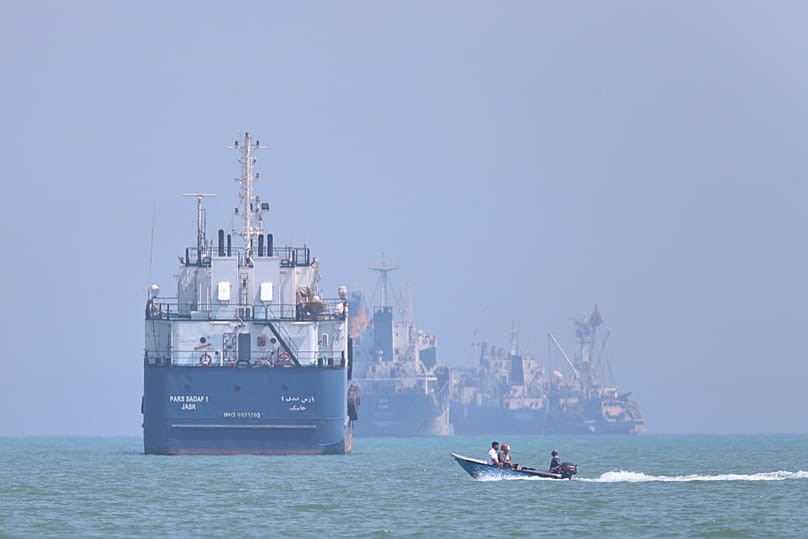
A small motorboat passes anchored vessels in the Strait of Hormuz off Bandar Abbas, Iran, Thursday, June 11, 2026. AP Photo
Sharif had said earlier in the day that a deal was closer “than ever before”. “With finalisation likely expected in the next 24 hours, Pakistan is preparing for the electronic signing of the peace deal immediately after, followed by technical level talks next week,” he wrote on X.
Qatar, which came to the fore in recent days as another key negotiator in the talks between Iran and the US, welcomed on Sunday night the deal reached between the two sides, “including ensuring freedom of navigation in the Strait of Hormuz, and considers it an important step towards consolidating sustainable peace and promoting economic growth regionally and internationally.”
“The Ministry of Foreign Affairs expresses the State of Qatar’s appreciation for the determination of both the American and Iranian sides and their commitment to moving forward in resolving differences through negotiations and peaceful means,” the ministry said on X.
A Qatari delegation was in the Iranian capital earlier on Sunday as negotiations continued. The Tasnim news agency said the delegation was to “examine the latest developments related to the diplomatic process”.
The deal still hinges on Tehran agreeing to fully reopen the Strait of Hormuz, a vital oil and gas transit chokepoint, and to end its nuclear arms programme. Trump said Saturday that a deal would be a “wall to no nuclear weapon”.
“Hopefully, this process will all work out quickly, easily, and smoothly. If it doesn’t, we have the ultimate alternative, hopefully never to be used again,” Trump warned.