

Government left GH₵24 billion of its first-quarter 2026 budget unspent and collected GH₵2.7 billion less revenue than it had targeted, according to Finance Ministry fiscal data on central government operations for January to March.
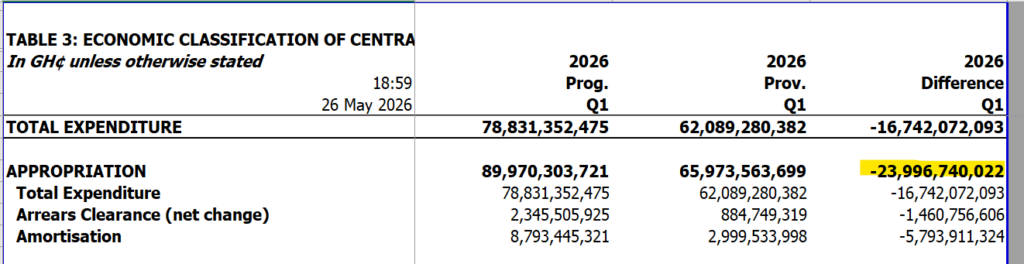
A JoyNews Research analysis shows that of the GH₵89.97 billion approved for the quarter, an envelope that covers spending on goods and services, debt repayment and the clearance of arrears, the Finance Ministry spent GH₵65.97 billion, or 73.3 percent with about 27 percent left unspent. Total revenue and grants reached GH₵57.5 billion against a programme of GH₵60.3 billion, a shortfall of 4.5 percent.
The figures land at a politically sensitive moment, with the Finance Ministry and the Ministry of Food and Agriculture trading public accusations over how much money has actually reached spending agencies this year.
Capital projects bore the heaviest cut
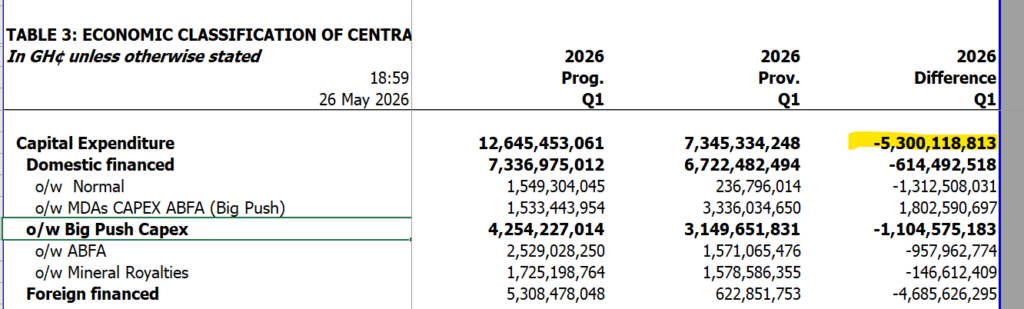
Capital expenditure absorbed the largest single reduction. The government had programmed GH₵12.6 billion for the quarter but spent GH₵7.3 billion, a shortfall of 41.9 percent.
Big Push capital expenditure fell short by more than GH₵1 billion relative to the planned budget of GH₵4.25 billion. Almost all of the gap sat on the foreign-financed side, where just GH₵0.6 billion of a planned GH₵5.3 billion was spent, a miss of 88.3 percent that mirrored a sharp slowdown in project loans and donor grants. Domestically financed capital projects fared far better, coming in only 8.4 percent below programme at GH₵6.7 billion.
Statutory funds received less than budgeted
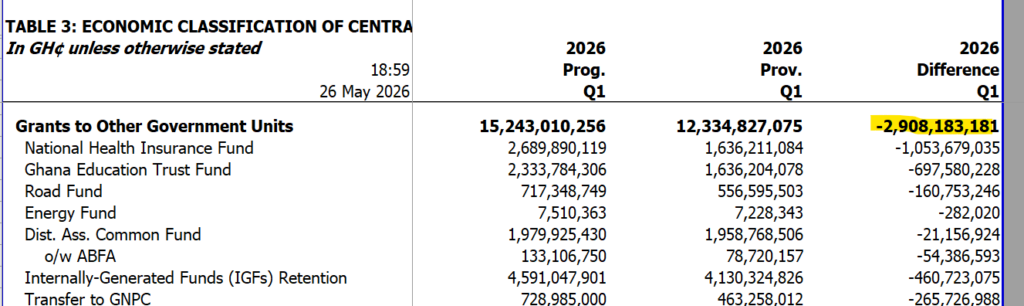
Transfers to other government units, which channel money to the country’s earmarked funds, reached GH₵12.3 billion against GH₵15.2 billion programmed, a shortfall of 19.1 percent. The squeeze touched the major funds directly. The National Health Insurance Fund received GH₵1.6 billion of a programmed GH₵2.7 billion, a gap of 39.2 percent, while the Ghana Education Trust Fund got GH₵1.6 billion against GH₵2.3 billion, down 29.9 percent.
Road Fund suffered a GH₵160.75 million shortfall, with the District Assemblies Common Fund falling short by about GH₵21.16 million.
Operations, wages and welfare
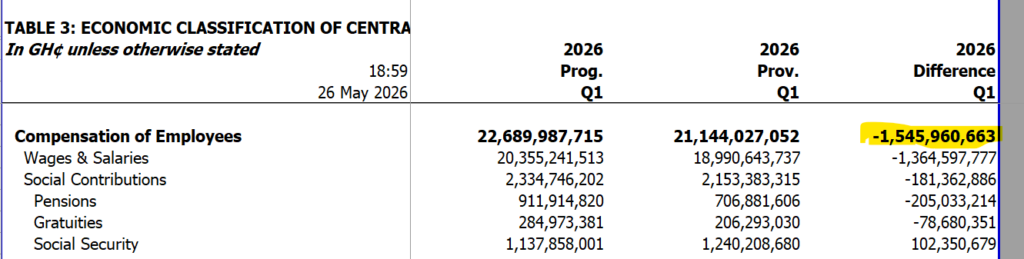
Spending on goods and services, the money that keeps ministries and agencies running day to day, fell 35.3 percent to GH₵1.3 billion from GH₵2.0 billion. Compensation of employees, normally the most rigid line in the budget, came to GH₵21.1 billion against GH₵22.7 billion programmed, a shortfall of 6.8 percent driven by wages and salaries running 6.7 percent light. Social benefits, programmed at GH₵0.5 billion, went entirely unspent during the quarter.
Debt repayments and interest lagged
The Finance Ministry’s planned servicing of debt budget fell below target. Amortisation, the repayment of loan principal, amounted to GH₵3.0 billion against GH₵8.8 billion due, leaving roughly two-thirds of the quarter’s scheduled repayments outstanding.
Interest payments came to GH₵17.2 billion versus GH₵21.7 billion programmed, a shortfall of 20.4 percent.
The gap was concentrated externally, where GH₵0.3 billion of a GH₵3.0 billion interest bill was paid, leaving 91.4 percent unpaid. Domestic interest, by contrast, ran close to plan at GH₵17.0 billion.
It is unclear if the big difference in debt servicing obligation is as a result of exchange rate dynamics or a general slowdown in debt repayment. Checks, however, show the cedi has generally remained stable against major trading currencies like the US dollar between quarter 4 of 2025 and quarter 1 of 2026 according to data pack released by the Bank of Ghana.


Revenue: where the GH₵2.7bn was lost
On the revenue side, the largest single disappointment came from domestic taxes on goods and services, which fell GH₵2.6 billion below target, a gap of 13.1 percent. Value added tax accounted for GH₵0.8 billion of that miss. Taxes on international trade brought in GH₵6.2 billion against GH₵7.2 billion expected, down 14.0 percent on softer import receipts.
Non-tax revenue, which includes fees, dividends and retained internal funds, came to GH₵6.2 billion against GH₵7.5 billion programmed, a shortfall of 17.7 percent. Oil revenue was proportionally the weakest performer, realising GH₵2.8 billion of a programmed GH₵4.5 billion, a gap of 37.6 percent. Programmed grants of GH₵0.6 billion failed to materialise entirely.
Not every line disappointed. Taxes on income and property came in at GH₵24.9 billion, ahead of the GH₵24.4 billion target, helped by company taxes that beat programme by 7.0 percent.
A public quarrel over what counts as a release
The gap between budgeted and actual spending has surfaced in an unusually public dispute between the Treasury and one of its biggest spending agencies. The two ministries are not arguing over a small discrepancy. They are describing the same budget in numbers that are barely recognisable as the same subject.
The Finance Ministry’s case rests on three claims. First, that it has released more than GH₵1.67 billion to the agriculture ministry in 2026, representing about 85 percent of the ministry’s allocation for goods and services and capital expenditure.
Second, that execution rates are high, with releases for goods and services reaching 94.73 percent and capital expenditure standing at 74.66 percent, which it presents as evidence of strong budget implementation.
Third, on the question of process, that with the exception of transfers to the National Food Buffer Stock Company, every request for funds was initiated by the agriculture ministry itself through the government’s GIFMIS financial management system and processed under standard procedures. In a separate exchange, the ministry has said its records carry requisition dates, journal numbers and warrant numbers to back each transaction.
The agriculture ministry rejects the figures and, more pointedly, the framing. It has accused the Finance Ministry of fabricating financial data and of using “infantile propaganda” to mislead the public, arguing that the Treasury has starved critical food security programmes while inflating figures in the media. Its counter-case is built on the official paperwork rather than on disbursement totals.
The ministry says it received a Commitment Authorisation on February 15, but that the First and Second Quarter Budget Allotment Letter issued four days later capped its expenditure for the first half of the year at GH₵910 million. The accompanying allotment schedule, it says, limited actual spending between January and June to about GH₵453 million, a sum that had to cover compensation, operational expenses and existing contractual obligations.
The ministry has gone further, itemising what the approved framework actually provided for its flagship programmes. Under that schedule, it lists GH₵172.5 million for Farmer Service Centres, GH₵77.3 million for fertiliser and certified seeds, GH₵36.75 million for the Nkokonkitinkiti Programme, GH₵30 million for the National Food Buffer Stock Company, GH₵26.25 million for irrigation infrastructure and GH₵4.5 million for the Feed Ghana Programme.
It maintains that it has received no subsequent authorisation or revised allotment that would support the claim of more than GH₵1.6 billion released.