

Beijing is strengthening its hold over Africa’s rare earth and critical minerals industry to secure global supply chains, while the United States is expanding its control over strategic maritime routes, including the Strait of Hormuz, to gain influence over China’s energy and industrial supply lines.
Washington has increased its presence along vital corridors such as the Panama Canal and the Strait of Hormuz, and is now pushing for wider access for US military aircraft through Indonesian airspace close to the Strait of Malacca.
Statistics indicate that a significant portion of China’s energy imports travels through exposed sea lanes, with about 45–50 percent of its crude shipments passing via the Strait of Hormuz. US enforcement actions targeting Iran have disrupted tanker traffic, including vessels supplying Chinese buyers.
Much of the remaining supply is transported through the Strait of Malacca, which carries roughly 60–80 percent of China’s oil imports.
Interruptions along these routes have led to shipment delays, higher costs, and slower industrial output in China, while a sustained US blockade could severely restrict supplies and trigger broader economic consequences, according to the BBC.
Washington’s efforts to secure these strategic chokepoints coincide with Beijing’s increased reliance on export restrictions.
These actions are viewed as a message to President Donald Trump, who is expected to visit Beijing in mid-May, as well as to other global leaders, that China retains a strong position in critical minerals and is prepared to counter moves that threaten its access to markets, technology, and industrial inputs.
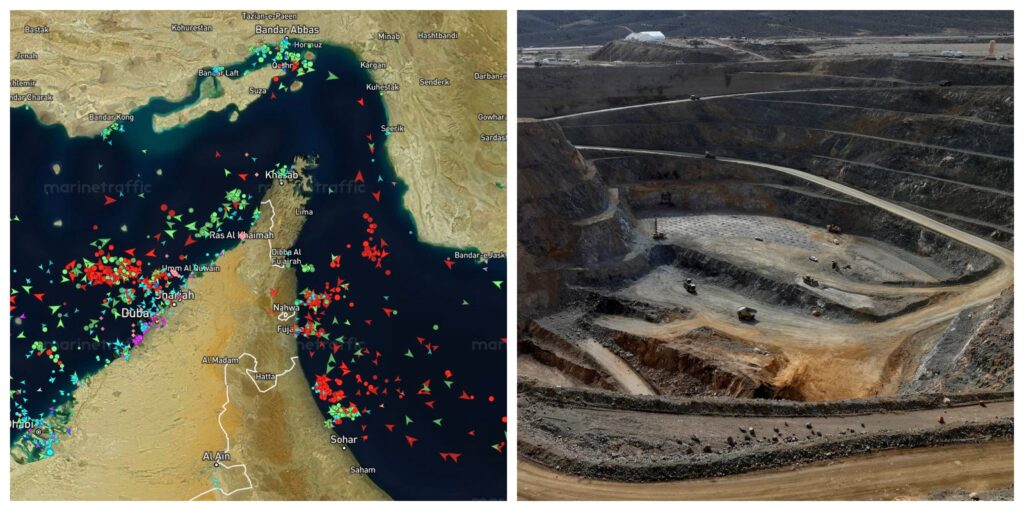
China strengthens African mineral foothold
Beijing’s growing influence is rooted in its dominance of rare earths and critical minerals, with supply networks increasingly tied to African resources.
China has expanded its footprint across Africa through strategic investments in mining assets, including taking control of Tanzania’s Ngualla rare earth project following a 2025 agreement involving Peak Rare Earths.
The Chinese-backed deal, valued at about $150 million, outbid a higher competing offer of roughly A$240 million (around $160 million) from General Innovation Capital Partners, giving Beijing control of one of the largest rare earth deposits outside China.
The site is projected to produce approximately 37,200 tonnes annually over two decades, supporting supply chains for magnets and electric vehicle production.
China has also acquired stakes in key African assets, including Botswana’s Khoemacau copper mine, Mali’s Goulamina lithium project, major mining operations in the Democratic Republic of Congo, and lithium processing ventures in Nigeria.
Chinese electric vehicle manufacturer BYD has secured access to six lithium mines across Africa, ensuring supply through 2032 and strengthening Beijing’s upstream control of battery materials.
Control of the full supply chain
Industry reports show that China’s strength goes beyond extraction, extending into dominance of the entire supply chain.
Chinese firms are investing at early exploration or feasibility stages, forming joint ventures and long-term offtake agreements that guarantee future supply.
State-supported lenders are funding projects that often struggle to attract Western investment, with mining loans linked to the Belt and Road Initiative reaching about $24.9 billion in the first half of 2025, while construction is usually handled by Chinese engineering firms.
Beijing also complements mining investments with infrastructure projects such as railways, roads, ports, and power facilities, integrating them into Chinese trade networks and ensuring efficient transport of minerals to global shipping routes heading to China.
Export controls as geopolitical tool
China’s strong position has allowed it to increasingly use export controls as a strategic lever in global politics.
Between 2021 and 2025, the country introduced export restrictions 30 times nearly three times the number recorded in the previous five-year period according to the EU Chamber of Commerce in China, as cited by the Financial Times.
Many of these measures targeted rare earth magnets and dual-use materials such as gallium, germanium, antimony, and graphite, which are essential for advanced manufacturing.
Beijing has also applied export controls during diplomatic disputes, including restricting shipments of rare earth materials and dual-use items to Japanese companies after Tokyo suggested that tensions over Taiwan could lead to military conflict.
These actions highlight China’s readiness to use its supply chain dominance as leverage.
US focuses on strategic chokepoints
Although US and Western mining firms are expanding operations in parts of Africa, they still lag behind China, which controls roughly 87 percent of global processing capacity.
China is responsible for about 70 percent of rare earth mining, 90 percent of separation and refining, and over 90 percent of rare earth magnet production.
In response, Washington is prioritising control of key maritime chokepoints to counter Beijing’s mineral dominance, focusing on transport routes rather than extraction.
While China continues to strengthen its control over resources and processing capabilities, the United States is working to gain influence over major shipping lanes and build strategic reserves to support its manufacturing, energy, and defence industries.