

Burkina Faso’s military leader, Ibrahim Traoré, has openly rejected democratic governance, asserting that it is ill-suited for the country. This statement marks a clear break from earlier promises to restore civilian rule and has raised renewed concerns about governance in the conflict-ridden Sahel nation.
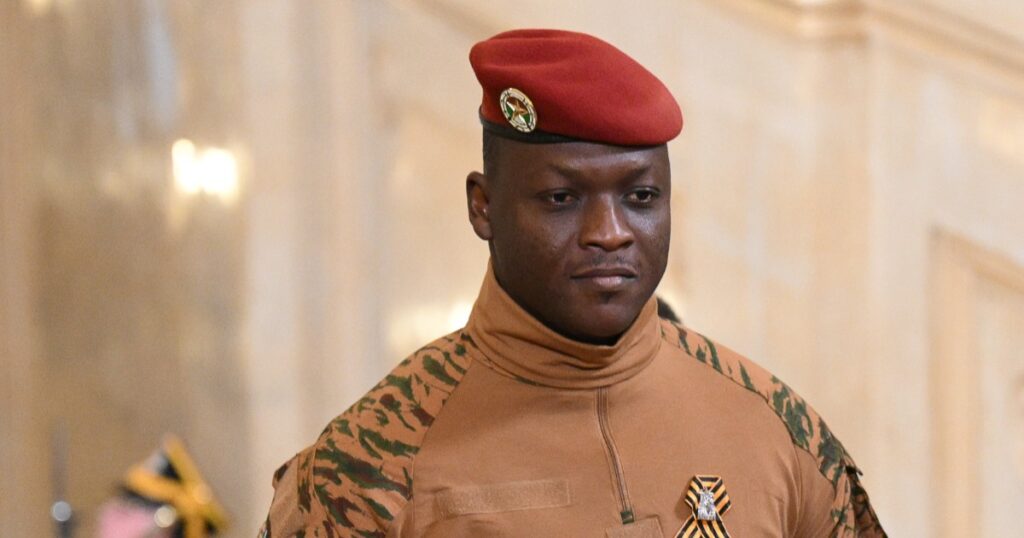
In a televised interview on Thursday, April 2, 2026, Traoré told reporters that citizens should “forget about the issue of democracy,” adding that “democracy isn’t for us.” He further characterized democratic systems as inherently violent, asserting that “democracy kills” and comparing it to “slavery.”
Using Libya as an example, Traoré argued that attempts by foreign powers to impose democracy had resulted in instability and widespread bloodshed. “Everywhere they try to establish democracy in the world, it’s done with bloodshed,” he stated, reflecting his administration’s increasingly anti-Western orientation.
These comments represent a sharp reversal from pledges made after Traoré seized power in September 2022, following a coup that ousted the democratically elected President Roch Marc Christian Kaboré. At the time, the military leadership had promised to restore democratic order and hold elections by 2024, but these plans have been postponed indefinitely. Traoré maintains that elections cannot occur until national security is ensured.
Escalating Violence Undermines Security Commitments
Burkina Faso faces a worsening security crisis, with armed groups affiliated with al-Qaeda and ISIL controlling extensive areas. Despite promises from the junta to prioritize security, violence has surged sharply.
Data from the Africa Center for Strategic Studies shows that fatalities have tripled since Traoré took power, reaching 17,775 by May last year, compared with 6,630 in the preceding three years. Civilians account for the majority of casualties, with some deaths linked to government forces and allied militias.
Alongside its stance on democracy, the regime has implemented sweeping political changes. In January, authorities dissolved over 100 political parties and seized their assets, effectively eliminating organized opposition. Parliament had already been suspended after the coup, and the electoral commission was disbanded in mid-2025, citing high operational costs.
Critics including opposition leaders, journalists, and legal professionals—have sounded the alarm over growing repression. Several regime critics have reportedly been forcibly conscripted and sent to the front lines, a move condemned by human rights organizations.
Regionally, Burkina Faso’s path mirrors that of neighboring Mali and Niger, both of which are under military rule. The three nations withdrew from the Economic Community of West African States (ECOWAS) and established the Alliance of Sahel States, signaling a deeper break from traditional regional frameworks.
These countries have also distanced themselves from former colonial power France, expelling its troops and increasingly relying on Russian paramilitary support. Despite these shifts, persistent security challenges leave Burkina Faso at a critical crossroads as its leadership redefines both domestic governance and international alliances.